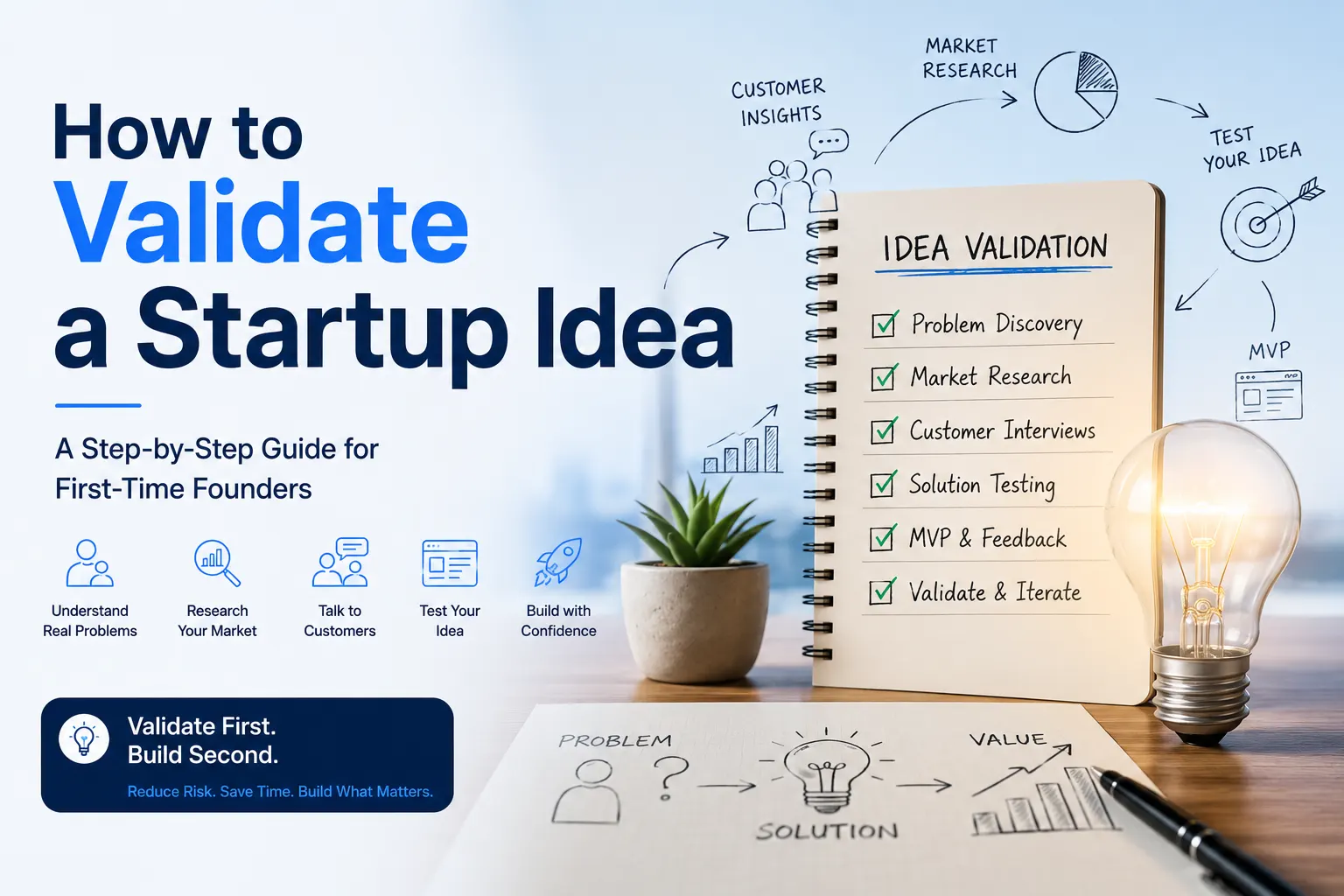
How to Validate a Startup Idea: A Step-by-Step Guide for First-Time Founders
Incubetr Team
·22 July 2026
How to Validate a Startup Idea: A Step-by-Step Guide for First-Time Founders
Most startups don't fail because founders couldn't build the product. They fail because nobody actually wanted what got built. Study after study of failed startups points to the same root cause, over and over: the team built first and checked for demand later, if at all.
That's exactly what this guide fixes. If you want to know how to validate a startup idea before you quit your job, spend your savings, or write a single line of code, this is the complete process — from defining the problem through to measuring real product-market fit.
This approach borrows heavily from Lean Startup thinking: treat your idea as a set of assumptions, not a finished plan, and test the riskiest ones first — cheaply, with real people, before you build anything permanent. Every step below exists to answer one question a little more confidently: is this a problem people actually want solved badly enough to pay for, or is it just a problem you find personally interesting?
Table of Contents
- Why Startup Validation Matters
- Step 1: Define the Problem
- Step 2: Identify Your Ideal Customer
- Step 3: Research the Market
- Step 4: Analyze Competitors
- Step 5: Interview Potential Customers
- Step 6: Create a Value Proposition
- Step 7: Build a Landing Page
- Step 8: Validate Interest
- Step 9: Build an MVP
- Step 10: Collect Feedback
- Step 11: Measure Product-Market Fit
- Startup Validation Checklist
- Common Validation Mistakes
- When Should You Pivot?
- FAQs
- Final Thoughts
Why Startup Validation Matters
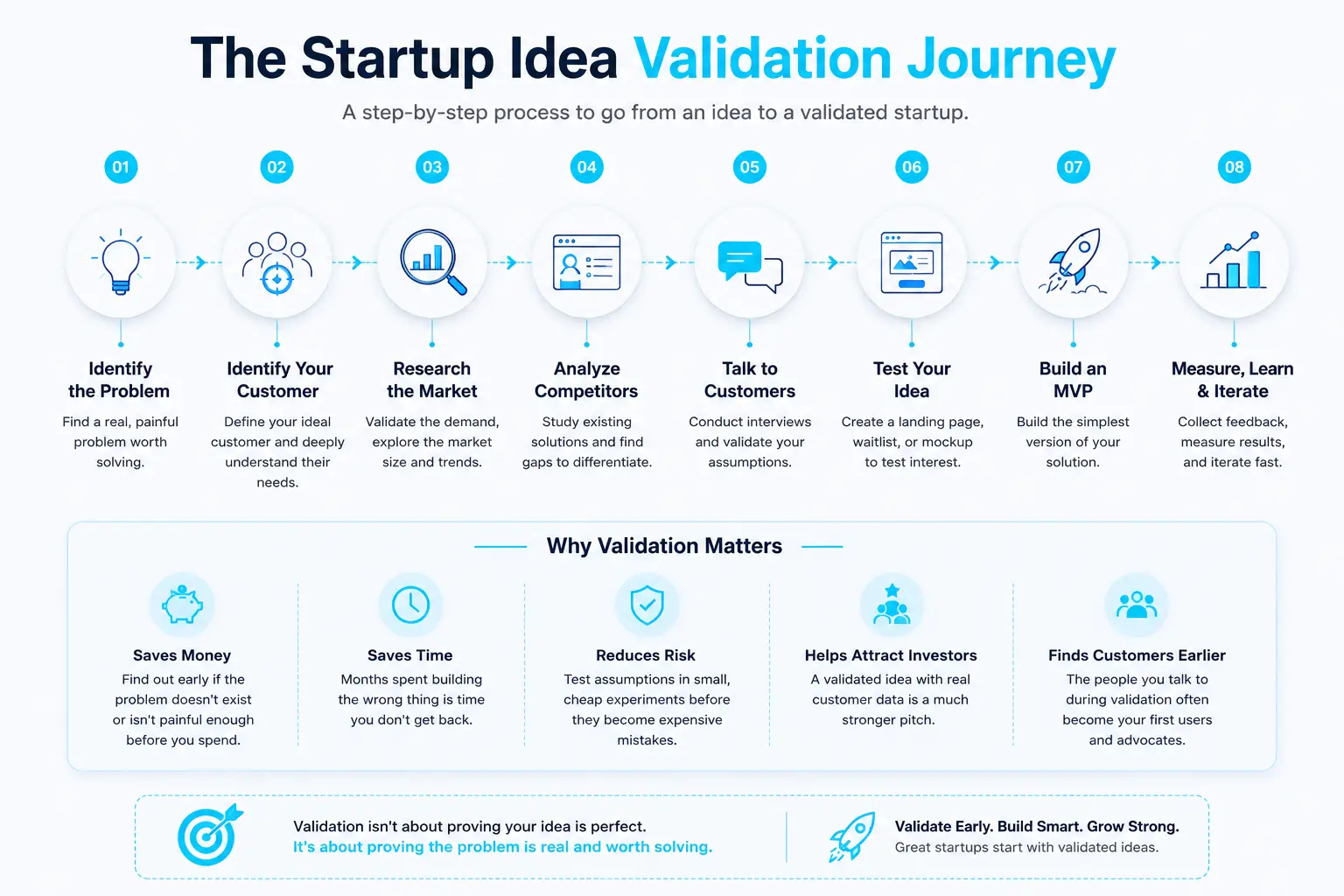
Validation isn't a formality before the 'real work' starts — it is the real work, early. Skipping it is the single most expensive mistake a first-time founder can make. Done properly, startup validation:
- Saves money — you find out a problem doesn't exist, or isn't painful enough, before you've spent on development, hosting, or a team
- Saves time — months spent building the wrong thing is time you don't get back, and in a startup, time is often the scarcer resource
- Reduces risk — every assumption gets tested in small, cheap experiments before it becomes a sunk cost you're emotionally attached to defending
- Helps attract investors — a validated idea backed by real customer conversations, signups, and usage data is a fundamentally different pitch than 'I think people would want this'
- Finds customers earlier — the people you interview and email during validation often become your first users, your first testimonials, and sometimes your first referrals
Skipping this stage doesn't just risk a slower start — it's the most common reason startups burn through their entire runway building a product that never finds its audience. If you haven't yet worked through the broader picture of what comes after validation, our guide on startup support for entrepreneurs covers the full idea-to-launch journey this fits into.
Step 1: Define the Problem
Don't start with 'I have an app idea.' Start with the problem statement: what problem are you actually solving, for whom, and why does it matter enough for someone to change their behavior?
Answer these before moving on:
- Who has this problem?
- How often do they run into it?
- How painful is it, really — an inconvenience or something they actively try to solve?
- Are they already paying for a workaround, a competitor, or a manual process?
That last question matters more than it seems. If people are already spending money or serious effort solving this problem badly — juggling three spreadsheets, paying for a clunky tool they complain about, hiring someone part-time just to manage it — that's a stronger validation signal than any survey response.
Write your problem statement down in one sentence, in the customer's words rather than yours: 'Small restaurant owners waste hours every week manually reconciling delivery-app payouts against their POS system' is testable. 'There should be an app for restaurant finance' is not.
Step 2: Identify Your Ideal Customer
Once the problem is clear, get specific about who has it. A vague target audience ('everyone who runs a small business') is nearly impossible to validate against. A customer persona gives you something concrete to test:
- Demographics — occupation, income range, age
- Behaviour — how they currently solve this problem, where they spend time online, what tools they already use
- Needs — what outcome they actually want, not just the feature they'd ask for
The narrower and more specific this persona is at the start, the easier every later step becomes — market research, interviews, and even your landing page copy all get sharper.
For example: 'Priya, 29, runs a two-location cafe business, handles her own bookkeeping on weekends, and currently uses three different apps plus a notebook to track delivery-app payouts' is something you can go find and talk to. 'Restaurant owners' is not. The more real this person feels, the easier it becomes to find ten of them to interview in Step 5.
Step 3: Research the Market
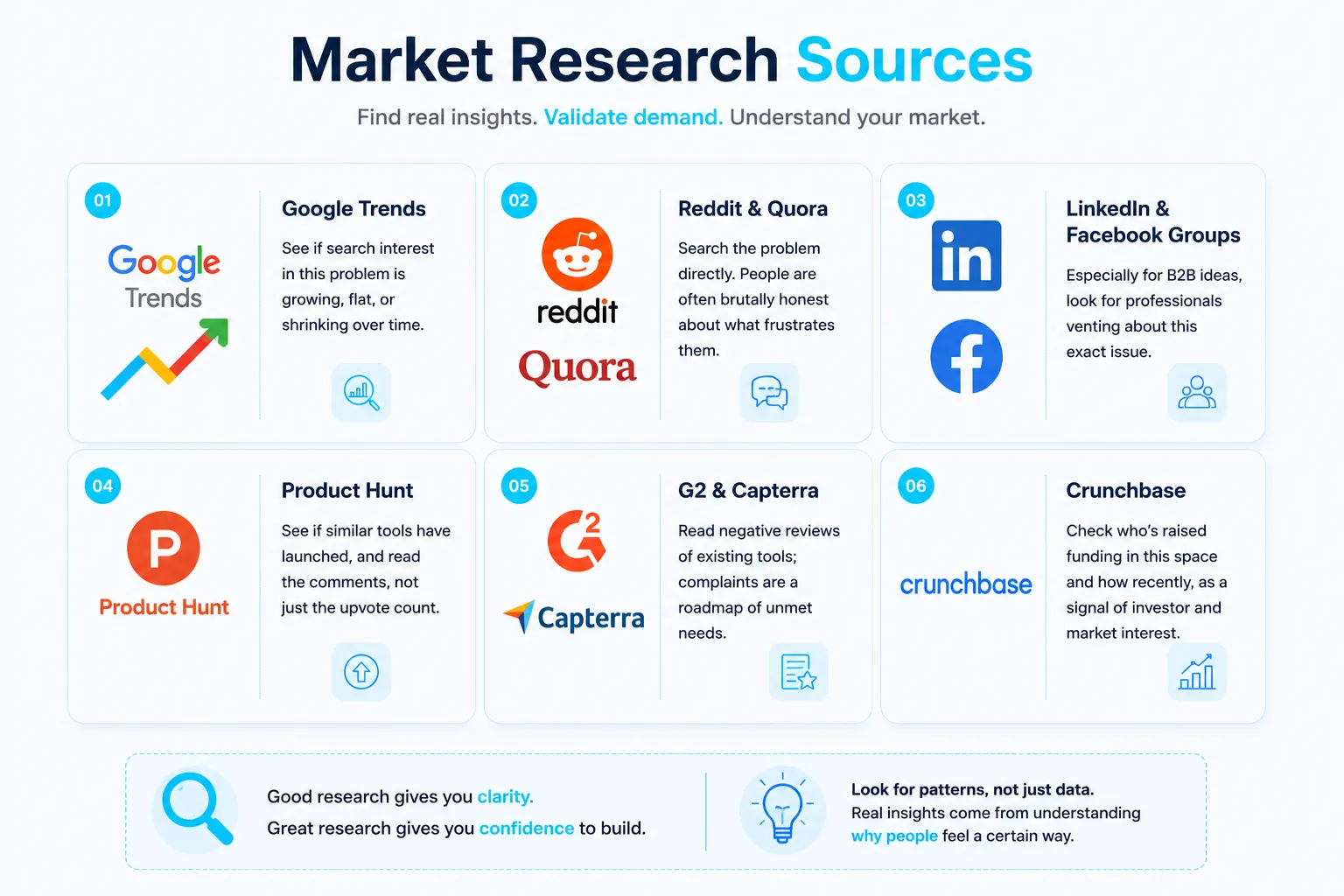
Market research isn't about finding a market-size number to put in a slide — it's about confirming demand actually exists and understanding how people currently talk about the problem. Useful sources:
- Google Trends — is search interest in this problem growing, flat, or shrinking?
- Reddit and Quora — search the problem directly; people are often brutally honest here about what frustrates them
- LinkedIn and Facebook Groups — especially for B2B ideas, look for professionals venting about this exact issue
- Product Hunt — see if similar tools have launched, and read the comments, not just the upvote count
- G2 and Capterra — read negative reviews of existing tools; complaints are a roadmap of unmet needs
- Crunchbase — check who's raised funding in this space and how recently, as a signal of investor and market interest
You're not looking for proof no one has tried this before. You're looking for evidence that people care enough to talk about it, complain about it, or pay for a partial fix.
As you go, keep notes organized against a simple Business Model Canvas — even a rough one, covering customer segments, value proposition, channels, and revenue streams. It turns scattered research into one document you can keep updating as evidence comes in, rather than a pile of open browser tabs.
Step 4: Analyze Competitors
A common instinct is to panic when competitors show up in your research. Don't. Competition proves demand — if nobody else is solving this problem in any form, that's often a bigger warning sign than a crowded market.
Look at three categories:
- Direct competitors — companies solving the same problem the same way
- Indirect competitors — companies solving the same problem a different way
- Alternative solutions — spreadsheets, manual processes, or 'doing nothing' as the current default
For each, note what they charge, what customers complain about in reviews, and what they clearly haven't solved yet. That gap is often where your value proposition lives.
| Competitor Type | What to Check | What You're Looking For |
|---|---|---|
| Direct | Pricing, reviews, feature set | Recurring complaints, unmet needs |
| Indirect | How they frame the problem differently | Whether customers switch between approaches |
| Alternative (manual/DIY) | How much effort the workaround takes | How painful 'no solution' really is |
A crowded market with clear, repeated complaints in the reviews is often a better sign than an empty one — it usually means real money is already moving, just not to a solution people are happy with.
Step 5: Interview Potential Customers
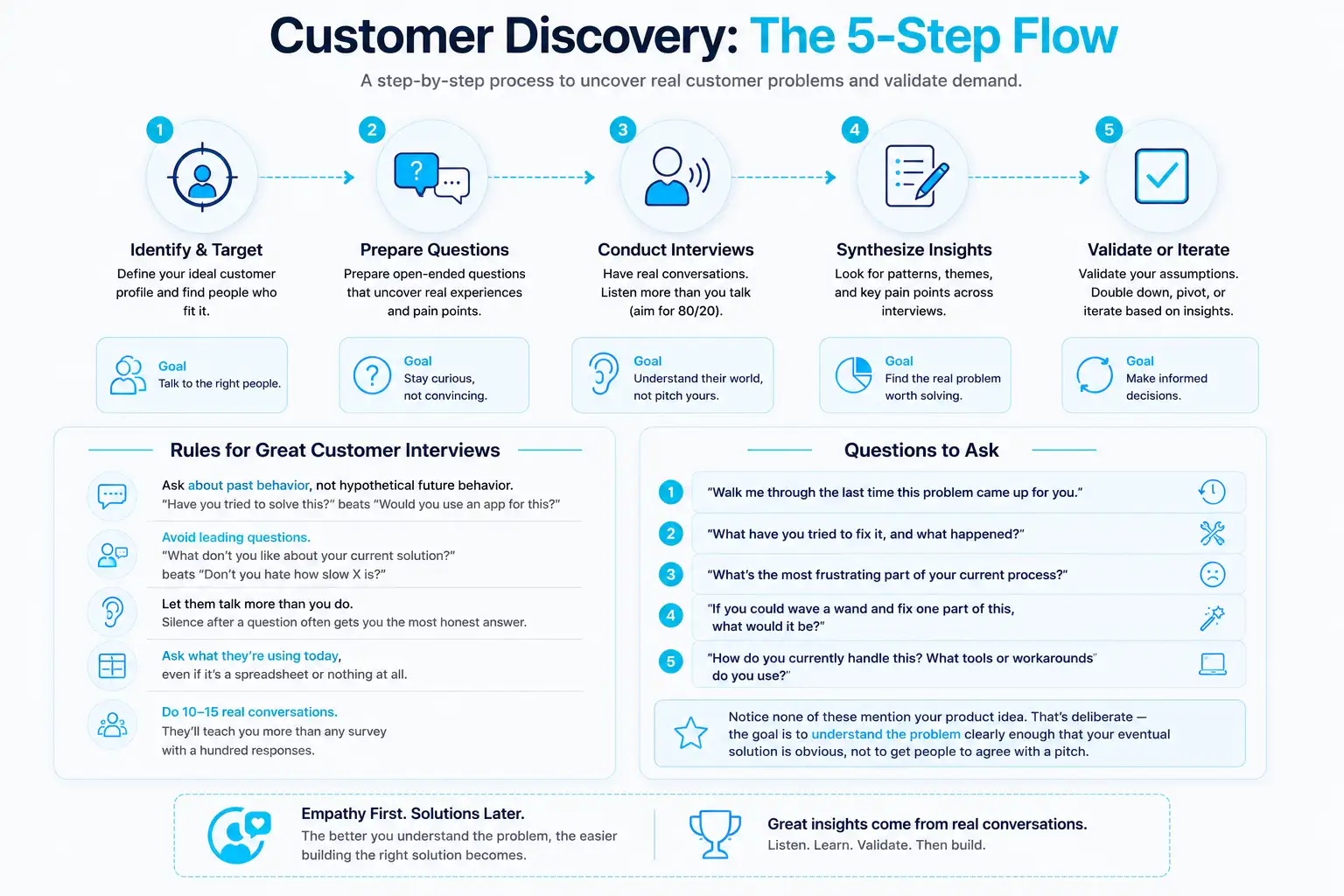
This is the step founders skip most often, usually because it's uncomfortable. It's also the one that matters most. Customer discovery means talking to real potential customers — not friends, not family, not people who'll tell you what you want to hear.
A few rules that make these interviews actually useful:
- Ask about their past behavior, not hypothetical future behavior ('have you tried to solve this?' beats 'would you use an app for this?')
- Avoid leading questions — 'what don't you like about your current solution' beats 'don't you hate how slow X is?'
- Let them talk more than you do. Silence after a question often gets you the most honest answer.
- Ask what they're using today, even if it's a spreadsheet or nothing at all.
Ten to fifteen real conversations will usually tell you more than any survey with a hundred responses.
A few questions worth having ready:
- 'Walk me through the last time this problem came up for you.'
- 'What have you tried to fix it, and what happened?'
- 'What's the most frustrating part of your current process?'
- 'If you could wave a wand and fix one part of this, what would it be?'
Notice none of these mention your product idea. That's deliberate — the goal is to understand the problem clearly enough that your eventual solution is obvious, not to get people to politely agree with a pitch.
Step 6: Create a Value Proposition
Once you understand the problem and the customer, put your solution into a single clear statement. A simple framework:
Problem → Solution → Benefits → Why You
Your value proposition should answer, in plain language, what makes your solution better than the alternative someone is using today — not a list of features, but the actual outcome it gives them.
Try filling in this single sentence: 'For [target customer], who [has this problem], our [product] is a [category] that [key benefit] — unlike [current alternative], we [key differentiator].' If you can't complete that sentence clearly after your interviews, that's a sign you need a few more conversations before moving forward. If you're not sure how this fits into your broader plan, our guide on how to write a startup business plan covers where the value proposition and business model fit together.
Step 7: Build a Landing Page
At this stage, you're not building the product — just a landing page that describes it. Keep it simple:
- A clear headline stating the problem and your solution
- 2–3 key benefits, written from the customer's perspective
- An email signup or waitlist form
- One clear call to action
The goal isn't traffic yet. It's a real artifact you can point people to during interviews, ads, or social posts, and measure actual interest against.
Keep the copy focused on the outcome, not the mechanics of how your product works internally — the same value proposition sentence from Step 6 makes a strong headline. A single, focused call to action (join the waitlist, get early access) beats three competing buttons every time.
Step 8: Validate Interest
Now drive some real attention to that landing page and measure what happens. Buffer, the social media scheduling tool, famously validated interest with nothing more than a landing page and a pricing page before writing any code — and used the signup numbers to decide whether to build at all.
Methods worth trying:
- Waitlist and newsletter signups
- Small paid ads on social platforms
- Organic social media posts describing the problem
- A Product Hunt 'coming soon' page
- Cold email to your exact target persona
Measure click-through rate, signup rate, and — if you're emailing people directly — reply rate. These numbers won't be perfect, but a landing page nobody signs up for is a real signal worth listening to.
This is also the right moment for early pricing validation — even a rough 'starting at ₹X/month' on the landing page tells you whether people balk at the number before you've built anything. It's uncomfortable to test, but far cheaper to learn now than after six months of development.
Step 9: Build an MVP
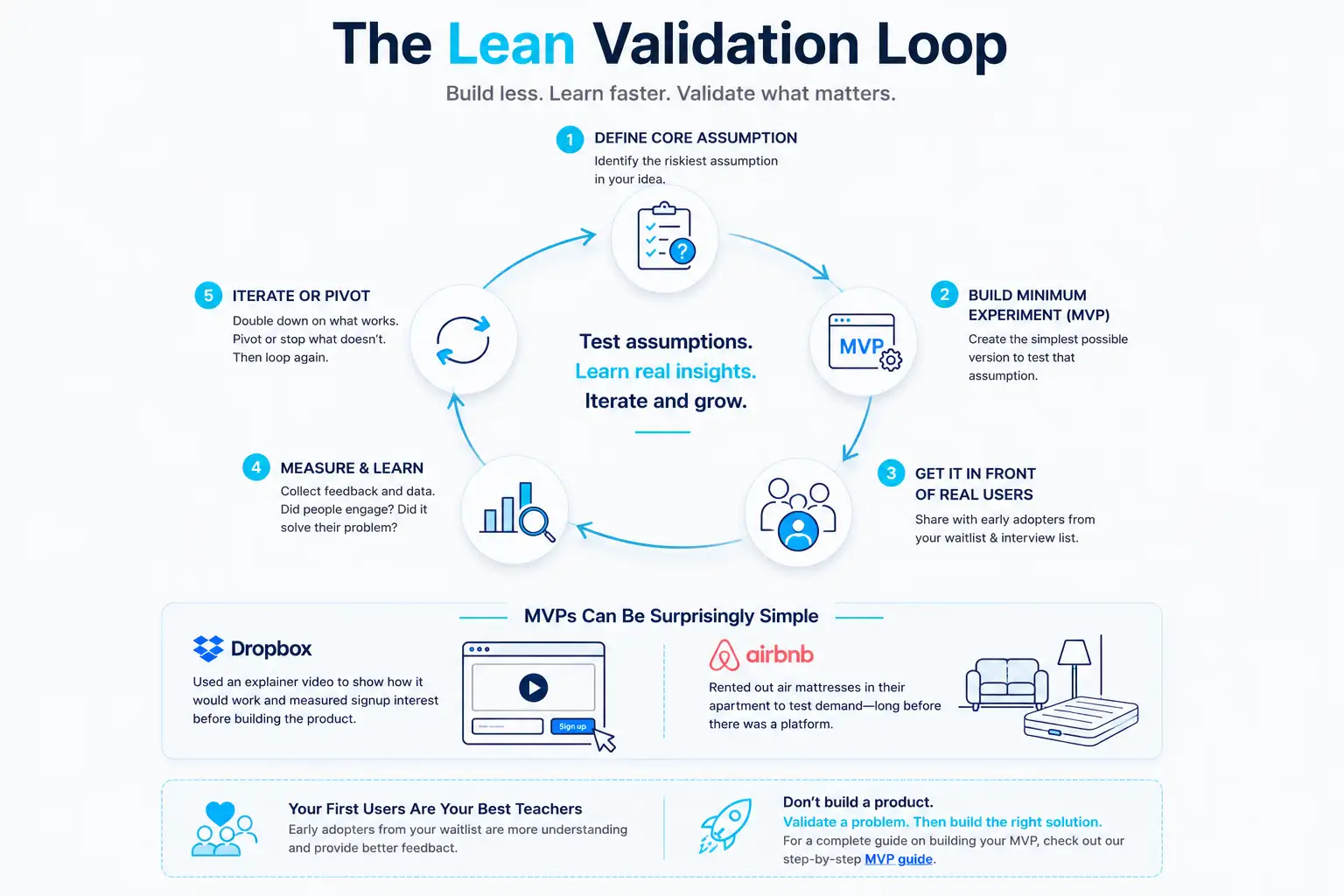
Don't build everything you've imagined. Build the smallest thing that lets you test your core assumption — this is your MVP (Minimum Viable Product), the simplest working version of your idea.
Two well-known examples show how far 'smallest possible version' can be stretched:
- Dropbox's first 'MVP' was just an explainer video showing how the product would work, used to gauge signup interest before the file-syncing technology was fully built.
- Airbnb's founders validated demand by renting out air mattresses in their own apartment to conference attendees — long before there was a platform, an app, or a business.
Your MVP doesn't need to be impressive. It needs to test one thing: will people actually use this to solve their problem?
Recruit your MVP's first users directly from the waitlist and interview list you've already built — these early adopters are more forgiving of rough edges and more generous with feedback than cold users will ever be, precisely because they've already told you they have the problem. For a deeper walkthrough of scoping and building this stage, see our guide on how to build an MVP.
Step 10: Collect Feedback
Once real users touch your MVP, feedback becomes your primary source of truth. Track:
- Retention — do people come back, or try it once and disappear?
- Usage — are they using the core feature, or just poking around?
- Reviews and NPS — would they recommend it to someone else with the same problem?
- Customer interviews — go back to the same people and ask what's working and what isn't
- Feature requests — what are people asking for that you didn't build?
Feedback at this stage is more valuable than any opinion collected before the MVP existed, because it's based on actual behavior, not a hypothetical.
Step 11: Measure Product-Market Fit
Product-market fit is the point where your solution and your market's needs actually click into place. This borrows from Lean Startup methodology — build, measure, learn, repeat — rather than a single moment you either hit or miss. Signals worth tracking:
- Activation — do new users reach the 'aha' moment quickly?
- Retention — do they keep coming back over weeks, not just days?
- Revenue — will people actually pay, and does that willingness hold at your intended price?
- Referral — do users tell other people about it unprompted?
- Engagement and repeat usage — is usage growing, or flattening out?
None of these need to be perfect early on. What matters is the trend — are they improving as you iterate, or staying flat no matter what you change?
Startup Validation Checklist
✔ Problem validated ✔ Ideal customer identified ✔ Market researched ✔ Competitors analyzed ✔ Customers interviewed ✔ Value proposition written ✔ Landing page live ✔ Interest validated (waitlist, ads, signups) ✔ MVP built ✔ Feedback collected ✔ Product-market fit measured
Common Validation Mistakes
Even founders who know they should validate often trip on the same mistakes:
- Building too early, before the problem is confirmed
- Asking friends and family, who rarely give honest, critical feedback
- Ignoring competitors instead of learning from their reviews and gaps
- Skipping research and relying on gut feeling alone
- Building every feature instead of the smallest testable version
- Not talking to customers directly, relying only on secondhand feedback
- Falling in love with the solution instead of staying attached to the problem
- Ignoring negative feedback because it's uncomfortable to hear
When Should You Pivot?
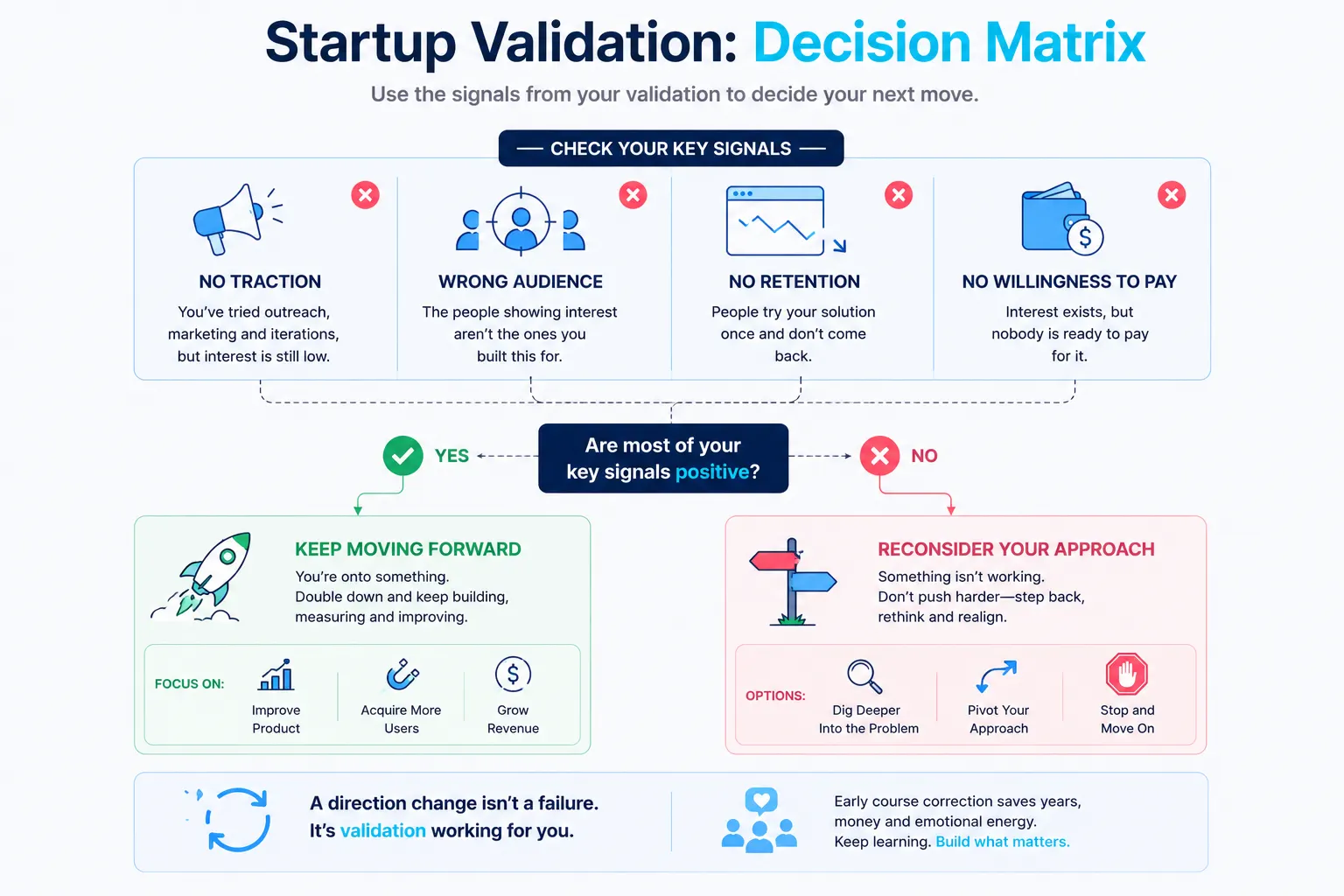
A few signs it's time to seriously reconsider your approach, rather than push forward on willpower alone:
- No traction, even after multiple rounds of outreach and iteration
- Wrong audience — the people who show interest aren't the ones you built for
- No retention — people try it once and never return
- No willingness to pay — interest exists, but nobody will actually spend money on it
A pivot isn't a failure. It's validation doing exactly what it's supposed to do: telling you early, before you've spent years on the wrong version of the idea.
FAQs
How do I know if my startup idea is good? You won't know from the idea alone — you'll know from evidence: real problem, real customers who confirm it, and real signals of willingness to pay or use it repeatedly.
How do I test a startup idea without building it? Start with customer interviews, a landing page, and a waitlist. You can validate real interest before writing a single line of product code.
How do I validate a SaaS idea specifically? The same framework applies, with extra attention to pricing validation early — SaaS customers need to see a clear cost-benefit case before they'll commit to a subscription.
How do I validate an app idea? Use an explainer video or clickable prototype instead of a full build, the way Dropbox tested demand before the underlying product existed.
How do I find product-market fit? Track activation, retention, and referral over time rather than looking for one single signal — product-market fit usually shows up as a trend, not a single milestone.
Final Thoughts
Validation never really stops. Even startups with paying customers and real traction keep testing new features, new markets, and new pricing the same way they tested the original idea. If you're figuring out how to validate a startup idea right now, treat it as the habit that carries your startup forward, not a box you check once before building.
Need help validating your startup idea? At Incubetr, we help entrepreneurs validate ideas, research markets, build business plans, develop MVPs, find co-founders, and prepare for funding — one connected process instead of six separate problems to solve alone. Explore how to find a co-founder, the complete guide to startup grants, our startup marketing guide, or the investor readiness checklist for the steps that come after validation.