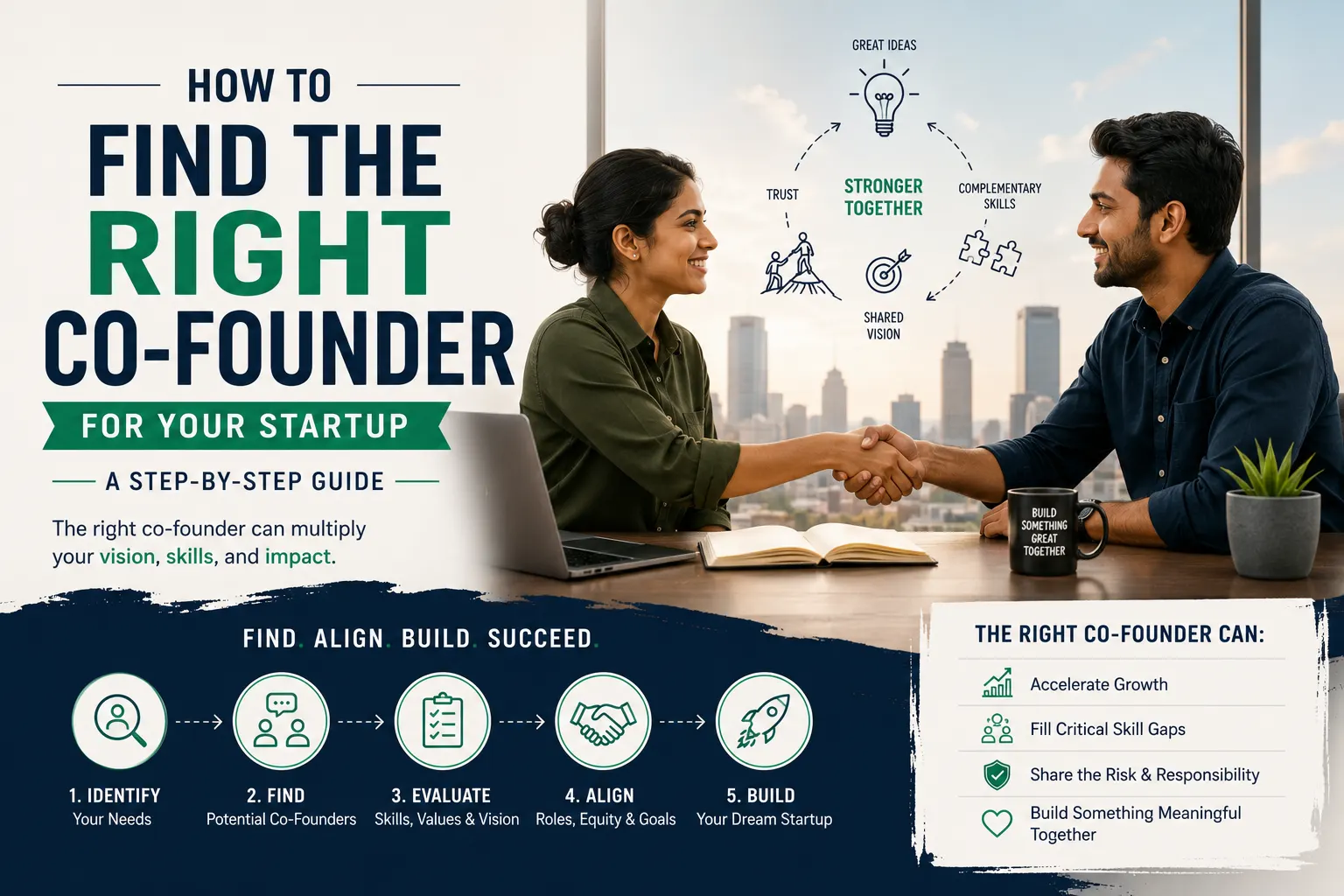
How to Find the Right Co-Founder for Your Startup: A Step-by-Step Guide
Incubetr Team
·22 July 2026
How to Find the Right Co-Founder for Your Startup: A Step-by-Step Guide
One of the biggest reasons startups fail isn't a lack of ideas — it's founder conflict. Two people who seemed perfectly aligned at the start drift apart over money, workload, or a disagreement neither saw coming, and the startup doesn't survive the fallout.
Choosing a co-founder is often a more consequential decision than choosing a technology stack or a business model. You can rewrite code and pivot a business model; unwinding a broken founding partnership, with equity and trust already tangled together, is far harder. This guide covers how to find the right co-founder for your startup — whether you need one at all, where to look, how to evaluate fit, and how to structure the partnership so it survives real pressure.
Most of the advice available to founders focuses on the idea itself — validation, the business plan, the product. Far less attention goes to the decision that quietly determines whether any of that work survives contact with reality: who you're building it with. A brilliant idea paired with the wrong founding partnership rarely gets a second chance to prove itself.
Table of Contents
- Do You Actually Need a Co-Founder?
- What Makes a Great Co-Founder?
- Identify the Skills You're Missing
- Where to Find a Co-Founder
- How to Evaluate a Potential Co-Founder
- Questions to Ask Before Partnering
- Equity Splits
- Founder Agreements
- Red Flags
- Common Co-Founder Mistakes
- Co-Founder Readiness Checklist
- FAQs
- Final Thoughts
Do You Actually Need a Co-Founder?
Not every startup needs one, and forcing a partnership because 'that's how it's done' can create more risk than it solves.
Advantages of having a co-founder:
- Shared workload across a genuinely large set of early responsibilities
- Complementary skills covering gaps you can't fill alone
- A second perspective on decisions made under pressure
- Shared accountability that keeps momentum going on hard days
Disadvantages:
- Diluted equity and decision-making authority
- Risk of conflict if roles, values, or expectations aren't aligned
- A partnership that's genuinely difficult to unwind if it doesn't work out
These trade-offs aren't symmetrical for every founder. Someone with deep technical skill and a strong existing network might find the disadvantages outweigh the benefits, at least at first, while someone strong on the product side but with no technical background often finds that the advantages — specifically, actually being able to build the thing — outweigh the loss of equity and control by a wide margin.
Stay solo if you already have the core skills the business needs, prefer full decision-making control, and can realistically sustain the workload alone, at least through early validation.
Bring someone in if you're missing a skill set critical to building or selling the product (most often technical ability, if you're a non-technical founder), if the workload is genuinely more than one person can sustain, or if you specifically want a thinking partner for high-stakes decisions.
There's no universally right answer here — plenty of successful startups are solo-founded, and plenty are built by strong founding teams. The decision should follow from what your specific business actually needs, not from an assumption that co-founders are always required.
A useful way to test your own instinct: imagine the hardest month of the next two years — a key customer churning, a technical failure, or a funding round falling through. Would you genuinely want to face that month with a specific partner beside you, or would you rather have made the decisions alone? Founders who answer that question honestly, rather than reflexively, tend to make a better call on whether to bring someone in and, if so, who.
What Makes a Great Co-Founder?
Skills matter, but they're rarely the deciding factor in whether a founding partnership survives its first real crisis. The qualities that matter more:
- Shared vision — genuine alignment on what you're building and why, not just enthusiasm for the idea in the moment
- Integrity — someone whose word matches their actions, especially when no one else is watching
- Commitment — a real willingness to stay through the slow, unglamorous middle of building a startup, not just the exciting launch
- Resilience — the ability to keep going after a bad week without spiraling or needing constant reassurance
- Problem-solving ability — a default instinct to find a path forward rather than assign blame when something breaks
- Communication — the willingness to raise a concern directly and early, rather than letting resentment build quietly
- Ownership mindset — treating the business's problems as their own, not as someone else's job to fix
Notice that most of these are about character and working style, not credentials. A brilliant resume paired with poor communication under stress is a far riskier bet than a less experienced partner who handles conflict directly and keeps their commitments.
It's worth being specific with yourself about which of these traits you're weakest at judging quickly. Most people can assess technical skill or industry experience reasonably well from a resume and a conversation. Integrity, resilience under real pressure, and true ownership mindset are much harder to judge from talk alone — which is exactly why the evaluation methods covered later in this guide lean so heavily on watching someone actually work, not just hearing them describe how they'd work.
Identify the Skills You're Missing
Before searching, get specific about what gap you're actually trying to fill. Common categories:
- Technical — building and maintaining the product
- Sales — closing early customers and partnerships
- Marketing — building awareness and demand
- Operations — running the day-to-day machinery of the business
- Finance — modeling, fundraising readiness, and financial discipline
- Product — translating customer needs into what actually gets built
- Legal — navigating contracts, IP, and compliance
Look for complementary skills, not a mirror of your own strengths. Two marketing-minded founders with no one who can actually build the product creates an immediate bottleneck; the goal is a founding team that, between the two or three of you, covers the core functions the business needs in its first year.
Be specific about depth, not just category. 'Technical' can mean anything from a hobbyist who's built one small app to a senior engineer who's shipped production systems at scale — the level of depth you need depends entirely on how technically demanding your specific product is, and it's worth being honest about which end of that spectrum your business actually requires before you start searching.
A simple exercise: list out every function your startup needs in its first twelve months — building the product, selling it, marketing it, handling the money, managing operations, and staying on the right side of legal requirements. Mark which ones you can genuinely own yourself, not just muddle through. Whatever's left unmarked is your real search criteria, and it's usually narrower and more specific than 'someone smart and hardworking.'
Where to Find a Co-Founder
A few reliable places to start, each with a different trade-off between speed and depth of relationship:
- Startup networking events and meetups — lower commitment, useful for meeting a wide range of people quickly
- Incubators and accelerators (Y Combinator, Techstars, and similar programs) — often bring together founders actively looking to team up, sometimes with structured co-founder matching built into the program
- LinkedIn — useful for identifying people with specific, verifiable professional backgrounds
- Wellfound (formerly AngelList) — has dedicated co-founder matching features aimed specifically at this search
- Founder communities (Founder Institute, Startup Grind, and similar groups) — often the best source of people who've already committed to the founder path, not just exploring it
- Hackathons and Startup Weekends — a fast, low-stakes way to see how someone actually works under real time pressure
- University alumni networks — especially useful if you're both early in your careers with fewer existing professional connections
- Your existing professional network — often overlooked, but former colleagues who've already seen how you work (and vice versa) come with a head start most strangers don't have
Whichever channel you use, treat the first conversation as the start of an evaluation process, not the end of the search. A promising first meeting is a reason to spend more time together, not a reason to commit immediately.
Different channels tend to surface different kinds of candidates. Incubator and accelerator cohorts often bring together people who are already fully committed to the founder path, which narrows the pool to serious candidates quickly. Broader platforms like LinkedIn and Wellfound cast a wider net but require more of your own filtering, since not everyone browsing is equally serious. Your existing network sits somewhere in between — a smaller pool, but one where you already have real signal on how someone actually behaves, which is often worth more than a larger pool of unknowns.
How to Evaluate a Potential Co-Founder
A practical framework to work through, ideally over several real interactions rather than a single conversation:
- Skills — do they genuinely have the expertise they claim, verified through past work or a real collaborative task
- Experience — relevant background, though not necessarily years in a specific industry
- Values — do they think about ethics, customers, and fairness the way you do
- Work ethic — do they follow through on small commitments consistently, not just big promises
- Risk tolerance — are they genuinely prepared for the financial and emotional uncertainty of early-stage startup life
- Communication style — do they raise problems directly, or let them build up silently
- Decision-making approach — do they lean toward data and discussion, gut instinct, or consensus, and does that mesh with how you decide things
- Availability — can they realistically commit the time this requires, given other obligations
The single most reliable way to evaluate most of these isn't a conversation — it's working on something small and real together before committing to anything permanent. A short shared project, even unpaid and informal, reveals how someone handles pressure, disagreement, and deadlines far more accurately than any interview-style conversation can. This is also the approach Incubetr's own co-founder matching is built around — pairing potential co-founders on real shared tasks before any formal commitment, rather than relying on a profile or compatibility quiz alone.
A useful trial project doesn't need to be elaborate. Something as simple as jointly building a rough landing page, running a handful of customer interviews together, or sketching out a first business plan draft as a pair will surface far more about compatibility than weeks of coffee meetings. Pay particular attention to how disagreements during that small project get resolved — that pattern, more than almost anything else, predicts how the partnership will handle disagreements once real money and equity are involved.
Questions to Ask Before Partnering
A few direct questions worth asking before things get serious:
- 'Why do you want to build this specifically, rather than something else?'
- 'How much time can you realistically commit, given everything else in your life right now?'
- 'What's your financial runway if this takes longer than either of us expects?'
- 'How do you typically handle disagreements, and can you give me an example?'
- 'What's your long-term goal here — building something to sell, to run for decades, or something else?'
- 'Would you keep working on this without funding for a year if it came to that?'
Vague or evasive answers to any of these are worth taking seriously — a founding partnership works best when both people can answer these honestly and specifically, not just optimistically.
It helps to ask these questions of yourself first, before asking a potential co-founder. If you can't answer your own runway or commitment-level question honestly, it's a sign you're not yet ready to evaluate someone else's answer fairly either. The goal of this exercise isn't to catch someone in a lie — it's to surface genuine misalignment early, while it's still cheap to walk away from.
Equity Splits
Equity conversations are uncomfortable, which is exactly why they get rushed or avoided — and exactly why rushing them causes problems later.
- Equal splits are simple and signal trust, but only make sense if contributions, risk, and commitment are genuinely comparable
- Unequal splits based on actual contribution — who had the original idea, who's committing full-time versus part-time, who's bringing existing IP or capital — are often fairer than a reflexive 50/50
- Vesting schedules protect everyone: equity is earned over time (commonly four years), so if a co-founder leaves early, they don't walk away with a large stake in a company they didn't help build long-term
- Cliff periods (commonly one year) mean no equity vests at all until that first milestone is reached, protecting the company from a co-founder who leaves within the first few months
Fairness matters more than mathematical equality. A 60/40 split that both founders genuinely believe reflects real contribution and risk is more durable than a 50/50 split one founder privately resents.
A practical way to reach a fair split: separately list out what each of you is bringing — the original idea, full-time versus part-time commitment, existing savings or capital contributed, relevant experience, and any IP or early work already done — and discuss the list together rather than starting from an assumed 50/50 default. Splits reached through this kind of explicit conversation tend to hold up better over time than ones settled quickly out of a desire to avoid an awkward discussion.
Founder Agreements
Put the following in writing before it matters, not after a disagreement forces the conversation:
- Roles and responsibilities — who owns which parts of the business day to day
- Decision-making — how disagreements get resolved, and who has final say on what
- Equity — the actual split, documented clearly
- Vesting — the schedule and cliff period, agreed in advance
- IP ownership — confirming that all IP created for the business belongs to the company, not to an individual founder personally
- Exit clauses — what happens, specifically, if one founder wants or needs to leave
A founder agreement isn't a sign of distrust — it's closer to a seatbelt. Everyone hopes not to need it, but its absence turns an ordinary disagreement into a much bigger problem, since there's no pre-agreed process to fall back on.
Draft this while the relationship is still calm and optimistic, not after the first serious disagreement has already happened. Founders who wait until tension arises to formalize an agreement often find the conversation itself becomes adversarial, precisely because it's now attached to a specific dispute rather than a shared, forward-looking plan. A modest amount of legal review at this stage — even a single consultation — is generally worth the cost relative to the risk of an undocumented dispute later.
Red Flags
Watch for these signals early, before equity and trust make them harder to walk away from. None are necessarily disqualifying in isolation, but they deserve a direct conversation rather than being quietly rationalized away:
- Chasing money instead of solving a problem — a co-founder more excited about a future exit than the actual customer problem
- Lack of commitment — vague or shifting answers about time and financial commitment
- Poor communication — avoiding hard conversations, or communicating passive-aggressively instead of directly
- Different values — real disagreement on ethics, customer treatment, or what 'success' actually means
- Unrealistic expectations — assuming rapid success without accounting for the actual work involved
- Refusing vesting — a strong signal someone expects the upside without matching long-term commitment
- No complementary skills — bringing largely the same strengths you already have, rather than filling a real gap
Any one of these alone might be worth a direct conversation rather than an immediate dealbreaker. Several together are a serious warning sign worth taking at face value.
The hardest version of this to catch is a red flag that only shows up under real pressure, since most people present well in a calm first conversation. This is another reason a small trial project matters so much — a disagreement over a minor task, or a missed small deadline during that trial period, is a far more honest preview of how someone behaves under stress than anything they'll tell you directly in an interview-style conversation.
Common Co-Founder Mistakes
- Choosing a friend without evaluating skills, assuming an existing friendship guarantees a good working partnership
- Splitting equity too quickly, before either of you has a real sense of actual contribution and commitment
- No legal agreement, relying on a verbal understanding that becomes contested memory later
- Avoiding difficult conversations early, letting small frustrations compound into resentment
- Ignoring culture fit, focusing entirely on skills while overlooking how genuinely well you work together day to day
Most of these mistakes share a common root: discomfort with an early, direct conversation leads founders to postpone it, and the postponed conversation eventually happens anyway — just later, under worse conditions, once equity and time are already invested. The founders who navigate this best tend to be the ones willing to have the awkward conversation in week two rather than avoiding it until month six.
Co-Founder Readiness Checklist
✔ Shared vision confirmed ✔ Complementary skills identified ✔ Roles clearly defined ✔ Founder agreement drafted ✔ Equity split discussed and agreed ✔ Vesting schedule and cliff period agreed ✔ Communication expectations aligned ✔ Long-term goals discussed honestly
FAQs
How do I find a technical co-founder if I'm not technical myself? Look specifically within developer-focused communities and platforms like GitHub, technical meetups, and hackathons, and prioritize working on a small real project together before committing — technical skill is one of the easier things to verify through actual collaborative work.
How do I split equity fairly with a co-founder? Base the split on actual contribution — idea origin, full-time versus part-time commitment, existing IP or capital brought in — rather than defaulting to an equal split out of discomfort with the conversation, and always pair it with a vesting schedule.
What should be in a co-founder agreement? At minimum: roles and responsibilities, decision-making process, equity split, vesting schedule, IP ownership, and exit clauses covering what happens if a founder leaves.
Can I find a co-founder online? Yes — platforms like Wellfound have dedicated co-founder matching features, and founder communities like Founder Institute and Startup Grind are commonly used starting points, though in-person or task-based evaluation still matters before committing.
How long should I know someone before making them a co-founder? There's no fixed timeline, but working together on a real, meaningful task — not just conversations — is a better indicator of readiness than any specific number of weeks or months.
What if my co-founder and I disagree on the vision later on? Revisit the shared vision conversation directly and often, rather than assuming early alignment holds automatically — a founder agreement's decision-making clause exists specifically to resolve exactly this kind of disagreement before it stalls the business.
Should I choose a friend or family member as a co-founder? An existing relationship can be a genuine asset, but it doesn't substitute for evaluating skills, values, and work style directly — treat a friend or family member exactly as rigorously as you would a stranger, since an existing bond raises the emotional cost of the partnership not working out.
Final Thoughts
A startup idea can change. Your product can pivot. Your market can evolve. Choosing the wrong co-founder, however, is one of the hardest mistakes to recover from — the equity, the trust, and the shared history all make an unwinding far messier than changing direction on the product ever is.
Treat the search itself with the same seriousness you'd give any other major, hard-to-reverse business decision. Take the time to evaluate through real shared work, have the uncomfortable conversations early, and put the agreement in writing before you need it — the extra weeks spent getting this right are consistently cheaper than the alternative.
Finding the right co-founder isn't about matching résumés — it's about finding someone who shares your vision, complements your strengths, and is committed to building for the long term. At Incubetr, we help founders connect with compatible co-founders through real, task-based evaluation, define clear roles, structure equity fairly, and build strong founding teams. Explore how to validate a startup idea, how to write a startup business plan, or our investor readiness checklist for the stages that follow once your founding team is in place.