How to Write a Startup Business Plan: A Step-by-Step Guide for First-Time Founders
Incubetr Team
·22 July 2026
How to Write a Startup Business Plan: A Step-by-Step Guide for First-Time Founders
Most first-time founders think of a business plan as a document they write once, mostly to satisfy investors, then never open again. That's the wrong way to think about it. If you're figuring out how to write a startup business plan, treat it as your decision-making framework — the thing you actually refer back to when deciding what to build next, who to hire, or how much runway you have left.
Done well, a startup business plan reduces uncertainty, aligns your team around the same priorities, makes fundraising conversations far more concrete, and keeps you focused when a dozen shiny new ideas compete for your attention in the same week. This guide walks through building one from scratch, step by step.
Table of Contents
- What Is a Startup Business Plan?
- Why Every Startup Needs a Business Plan
- When to Use a Lean Canvas Instead
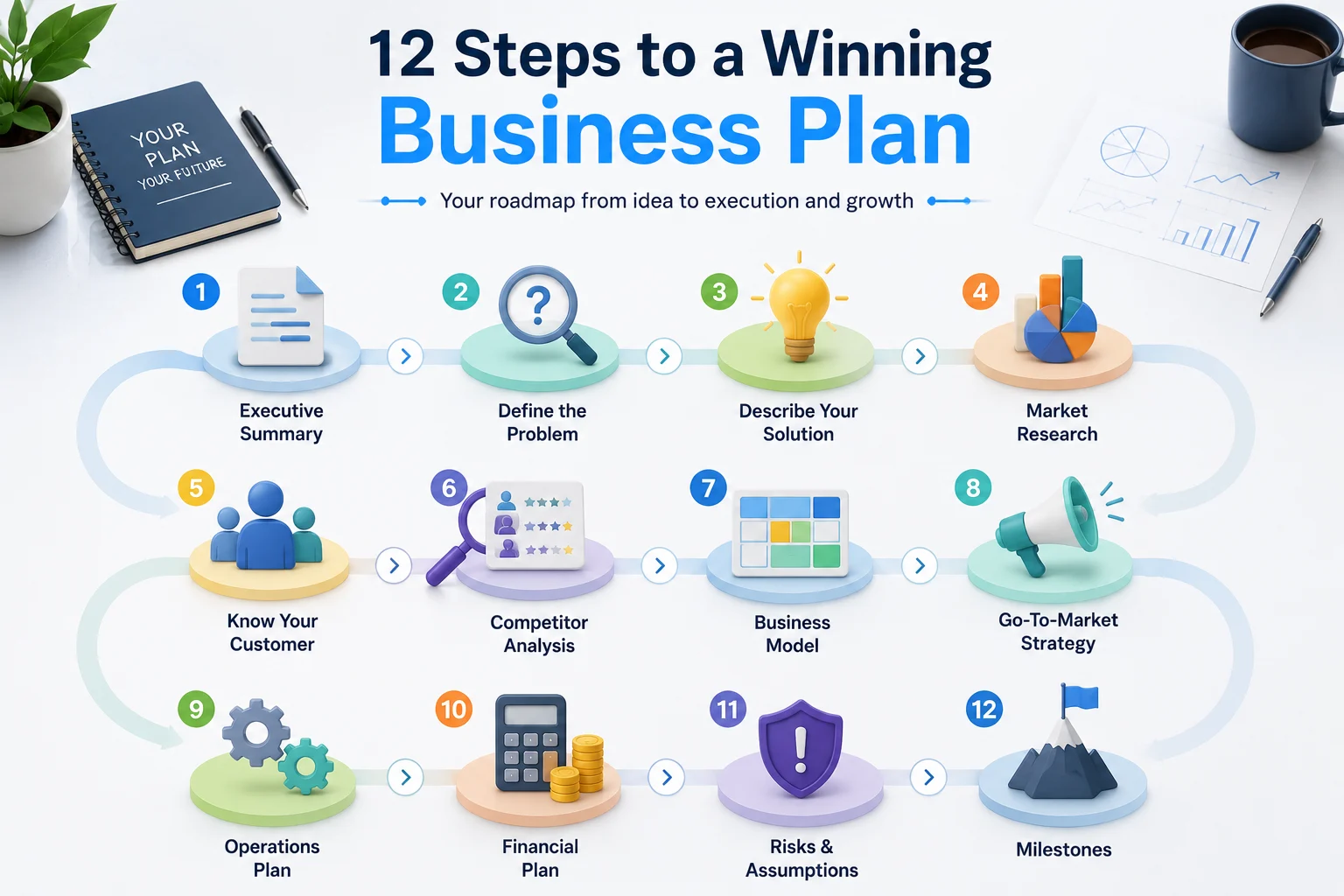
- Step 1: Executive Summary
- Step 2: Define the Problem
- Step 3: Describe Your Solution
- Step 4: Market Research
- Step 5: Know Your Customer
- Step 6: Competitor Analysis
- Step 7: Business Model
- Step 8: Go-To-Market Strategy
- Step 9: Operations Plan
- Step 10: Financial Plan
- Step 11: Risks & Assumptions
- Step 12: Milestones
- A Simplified Example Business Plan
- Common Mistakes
- Business Plan Checklist
- FAQs
- Final Thoughts
What Is a Startup Business Plan?
A traditional business plan was built for stable, established businesses — long, static, and written once for a bank loan or a board. A startup business plan is different in one important way: startups change quickly, so the plan has to evolve with them.
Think of it less as a finished document and more as your current best understanding of the business — updated every time customer discovery, market research, or an MVP teaches you something your original assumptions got wrong.
A traditional plan might sit untouched for a year between board meetings. A startup business plan is closer to a working notebook: you'll likely revise the customer persona after your first ten interviews, adjust the revenue model after your first pricing test, and rewrite the financial plan entirely once you have real usage data instead of guesses. The structure below stays roughly the same; the content inside it should change as you learn.
Why Every Startup Needs a Business Plan
- Clear direction — a written plan forces decisions that vague enthusiasm lets you avoid
- Better decisions — you can check any new idea against the plan instead of reacting to whatever seems exciting this week
- Easier fundraising — investors expect a coherent story connecting problem, solution, market, and numbers
- Team alignment — everyone working from the same understanding of the business, not five different versions in five people's heads
- Growth planning — you can see, on paper, what needs to be true for the business to scale
- Risk reduction — writing risks and assumptions down forces you to actually think about them, instead of discovering them the hard way
Founders who skip this step tend to make the same decisions repeatedly from memory and instinct, which works fine until the business grows past the point where one person can hold the whole picture in their head. Writing it down is what lets a second or third team member start making good decisions without you in the room.
When to Use a Lean Canvas Instead
A full startup business plan isn't always the right tool for where you are. A Lean Canvas — a simplified, one-page version covering problem, solution, key metrics, unique value proposition, channels, revenue streams, cost structure, and unfair advantage — is usually the better starting point when:
- You're still validating the idea and don't have real customer or revenue data yet
- You need something you can rewrite in an afternoon as assumptions change
- You're using it internally to align a small founding team, not presenting to outside investors
Move to a fuller business plan once you're validating with real customers, preparing for a funding round that expects financial projections, or bringing on hires who need more context than a one-pager provides. Many founders keep both — a Lean Canvas for fast internal iteration, and a full plan that gets updated less frequently for external conversations.
Step 1: Executive Summary
The executive summary goes first in the document but should be the last thing you write, once every other section is settled. It's a compressed version of the whole plan:
- Mission — why the company exists
- Vision — where it's headed long-term
- Problem — what you're solving
- Solution — how you solve it
- Target market — who it's for
- Revenue — how the business makes money
- Funding goal — how much you're raising and what it's for, if applicable
A useful test: if someone only reads this section and nothing else, they should understand what the company does, for whom, and why it matters — in under a minute.
Step 2: Define the Problem
Great startups solve genuinely painful problems, not mildly annoying ones. Before writing this section, make sure you can answer:
- Who has this problem?
- How often does it come up?
- What are they currently doing about it (current alternatives)?
- How painful is it, on a scale from 'minor inconvenience' to 'actively costing them money or time'?
If you haven't tested these answers with real customers yet, it's worth working through our guide on how to validate a startup idea before finalizing this section — a business plan built on an untested problem statement gets rewritten fast anyway.
Step 3: Describe Your Solution
Cover what the product actually does, but resist the urge to oversell it here. Structure this section around:
- Features — what it does
- Benefits — the outcome those features actually produce for the customer
- USP (unique selling point) — what makes this different from existing options
- Value proposition — the single clearest statement of why this is worth choosing
The strongest version of this section reads like a clear explanation, not a sales pitch — investors and early team members can tell the difference, and the plainer version is usually more convincing.
Step 4: Market Research
This section should show you understand the size and shape of the opportunity, not just that you're excited about it. Cover:
- TAM (Total Addressable Market) — the full market if you captured 100% of it
- SAM (Serviceable Addressable Market) — the portion you could realistically reach given your business model and geography
- SOM (Serviceable Obtainable Market) — what you could realistically capture in the next few years
| Market Layer | Illustrative Example |
|---|---|
| TAM | ₹8,000 Cr (all small businesses in the category, nationally) |
| SAM | ₹1,200 Cr (urban small businesses matching your target segment) |
| SOM | ₹15 Cr (realistic 3-year capture at current go-to-market capacity) |
These numbers are illustrative, not a template to copy — yours should come from your own research: industry reports, government data, and the market research and demand validation work covered in our idea validation guide. Round, defensible numbers backed by a clear method beat an impressively large TAM with no explanation behind it.
Alongside the market-size numbers, this section should also cover industry trends — is this market growing, shrinking, or shifting toward a different way of solving the problem — and a brief competitor landscape overview, expanded fully in Step 6. Investors read this section looking for one thing above all: evidence that the numbers came from real research, not a top-down guess starting from a huge global figure and working backward to something convenient.
Step 5: Know Your Customer
Build this section around a specific customer persona rather than a broad description:
- Demographics — age, income, industry
- Buying behaviour — how they currently make purchasing decisions
- Pain points — what specifically frustrates them today
- Goals — what outcome they're actually trying to reach
The more specific this persona is, the easier every later section — pricing, channels, messaging — becomes to write convincingly.
Step 6: Competitor Analysis
Don't skip or downplay this section — a business plan with no real competitor analysis reads as under-researched, not as evidence of a blue ocean.
| Competitor | Strength | Weakness | Pricing | Differentiator |
|---|---|---|---|---|
| Competitor A | Strong brand recognition | Slow customer support | Premium tier | Your faster onboarding |
| Competitor B | Low price point | Limited feature set | Budget tier | Your deeper integrations |
| Competitor C (manual/DIY) | Free, familiar | Time-consuming, error-prone | No direct cost, high time cost | Your automation |
Fill this table in with your actual competitors and real, sourced pricing — the structure above is a template, not a shortcut around the research itself.
Pay particular attention to the differentiator column. It's the weakest part of most first drafts, usually filled in with something vague like 'better UX' or 'more affordable.' A stronger differentiator is specific and defensible: a faster onboarding flow measured in minutes, an integration a competitor genuinely lacks, or a pricing structure built around how your specific customer segment actually wants to pay.
Step 7: Business Model
Be explicit about how the business actually makes money. Common startup revenue models include:
- Subscriptions — recurring monthly or annual revenue
- Marketplace — a commission on transactions between two sides
- Freemium — a free tier with paid upgrades
- One-time sales — a single purchase per customer
- Licensing — charging other businesses to use your technology
- Services — revenue tied to delivered work rather than a product alone
Most startups end up as some blend of these rather than a single pure model — name the primary one clearly, and be honest in the plan about which model you're betting on.
Step 8: Go-To-Market Strategy
This section explains how you'll actually reach the customer persona from Step 5. Common channels worth evaluating:
- SEO and content — for problems people actively search for
- Paid ads — when you know your unit economics well enough to spend confidently
- Social media — especially where your specific persona already spends time
- Partnerships and referral — often underrated for B2B and marketplace models
- Cold outreach — direct and effective early on, even if it doesn't scale forever
- PR — useful for credibility, rarely a primary acquisition channel on its own
Pick two or three to focus on early rather than listing all seven as equally important — a real go-to-market strategy makes choices. Our startup marketing guide covers how to evaluate and prioritize these channels in more depth.
Step 9: Operations Plan
Cover how the business actually runs day to day:
- Daily operations — what needs to happen every day, week, and month for the business to function
- Technology — the core systems and tools the business depends on
- Hiring — key roles you'll need, and roughly when
- Support — how customers get help
- Legal and infrastructure — registration, compliance, and any regulatory requirements specific to your sector
This section is often the shortest in early-stage plans, and that's fine — it should grow in detail as the team and operations actually grow.
For a pre-launch startup, this might be a few paragraphs covering which tools you'll rely on and who handles what among a two- or three-person founding team. For a startup past its first hires, it should start to cover org structure, standard operating procedures for recurring tasks, and how support requests actually get handled day to day — the goal is that someone new to the team could read this section and understand how the business runs without asking ten follow-up questions.
Step 10: Financial Plan
This is the section investors read most carefully, and the one founders are most tempted to inflate. Cover revenue, expenses, runway, break-even point, funding needs, and forecasts — and keep the numbers grounded in real assumptions you can defend.
| Month | Revenue (₹) | Expenses (₹) | Net Runway Impact |
|---|---|---|---|
| 1 | 0 | 2,50,000 | -2,50,000 |
| 2 | 0 | 2,50,000 | -2,50,000 |
| 3 | 25,000 | 2,60,000 | -2,35,000 |
| 4 | 60,000 | 2,70,000 | -2,10,000 |
| 5 | 1,20,000 | 2,80,000 | -1,60,000 |
| 6 | 2,00,000 | 2,90,000 | -90,000 |
This table is a simplified, illustrative example, not a projection to copy — actual figures should come from your real cost structure and pricing. What matters is showing the trend toward break-even clearly, with expenses and revenue assumptions an investor could reasonably question and you could defend.
Step 11: Risks & Assumptions
Every serious investor wants to see this section — leaving it out doesn't hide the risks, it just signals you haven't thought about them. Cover:
- Market risk — demand not materializing as expected
- Technology risk — build complexity or timelines slipping
- Hiring risk — difficulty finding the right people at the right time
- Funding risk — running out of runway before the next milestone
- Legal risk — regulatory or compliance issues specific to your sector
- Competition — a well-funded competitor moving into the same space
Name the two or three biggest risks honestly, along with what you'd do if each one materialized. That's more convincing than pretending none of them apply to you.
Step 12: Milestones
Lay out a realistic timeline connecting today to your next major goal:
Month 1: Idea validation → Month 2: Landing page live → Month 3: MVP built → Month 4: First 100 users → Month 5: First revenue → Month 6: Seed funding conversations
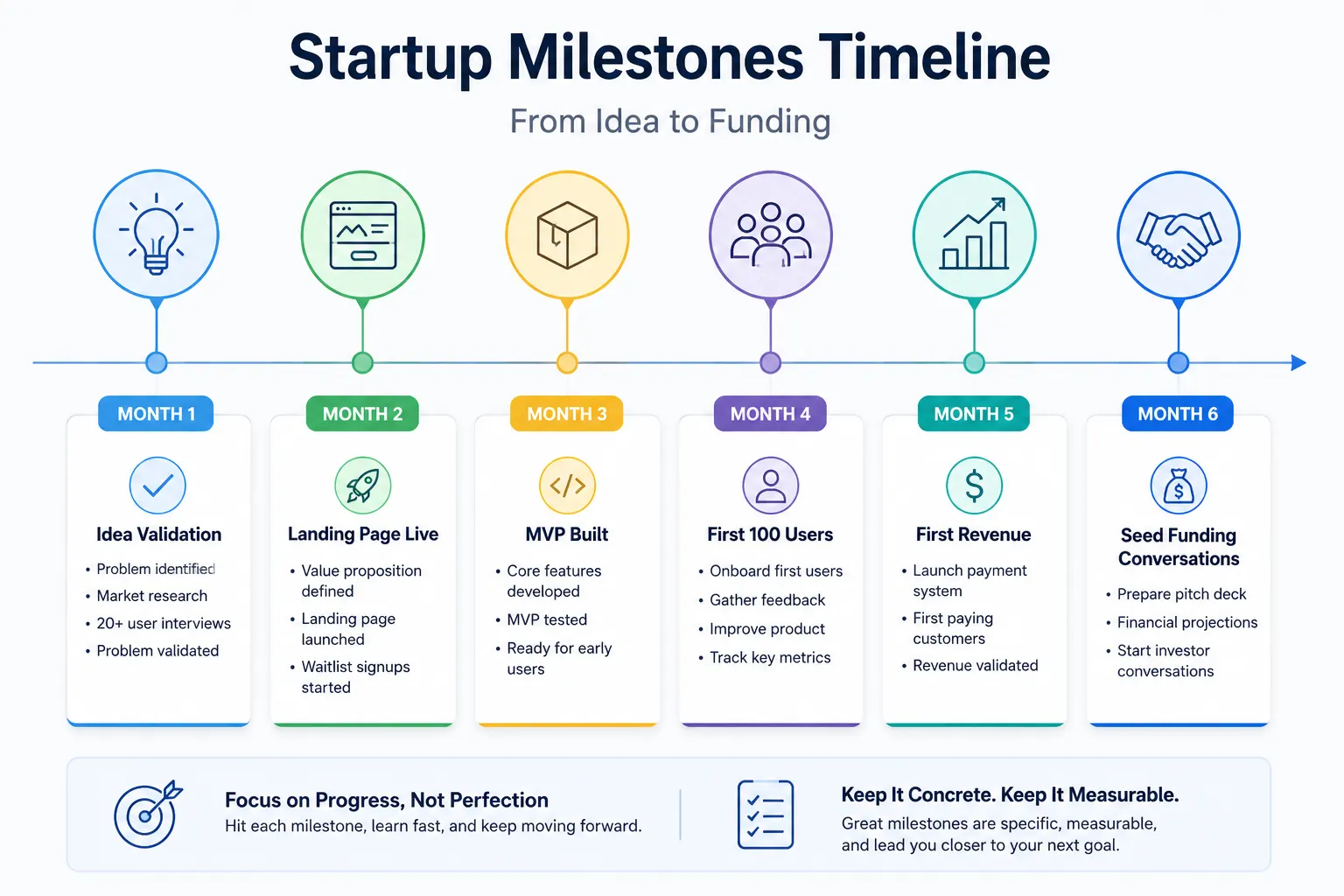
Adjust the specific milestones to your business, but keep them concrete and checkable — 'grow the user base' isn't a milestone, '100 paying users' is.
A Simplified Example Business Plan
To make this concrete, here's a short, fictional, simplified excerpt showing how these sections come together for an illustrative example startup:
Problem: Independent tutors in Tier 2 Indian cities lose an estimated 5–8 hours a month manually tracking student attendance and fee payments across WhatsApp and paper registers.
Solution: A lightweight mobile app that lets tutors log attendance in seconds and automatically calculates fees due, with reminders sent directly to parents.
Revenue Model: Freemium — free for up to 15 students, ₹299/month for unlimited students plus payment reminders.
This is intentionally short — a real version of each section would be several paragraphs, backed by actual interviews and numbers. The point is the shape: specific problem, specific solution, specific revenue model, all connected to each other rather than written in isolation.
Notice how each line refers back to something concrete — a specific city tier, a specific number of hours lost, a specific price point — rather than staying abstract. That's the difference between a business plan that reads as researched and one that reads as a guess dressed up in confident language. When you write your own version, resist the urge to round every claim up to sound more impressive; specific and modest beats vague and inflated in front of both investors and your own team.
Common Mistakes
- No real research behind market size or competitor claims
- Huge, unstated assumptions treated as facts
- Ignoring competitors instead of researching them honestly
- No financials, or financials that don't connect to the rest of the plan
- Being too optimistic about timelines, costs, or adoption speed
- Writing only for investors instead of a document the founding team actually uses
- Not updating the plan after validation, customer discovery, or MVP feedback changes what you know
Business Plan Checklist
✔ Problem ✔ Customer ✔ Market (TAM/SAM/SOM) ✔ Competitors ✔ Solution ✔ Revenue model ✔ Marketing / go-to-market ✔ Operations ✔ Financials ✔ Milestones ✔ Risks & assumptions
A printable version of this checklist, along with a simple Lean Canvas worksheet, is available as part of Incubetr's founder resources — see the investor readiness checklist for the fundraising-stage version of this process.
FAQs
Is there a startup business plan template I can just fill in? Yes — the twelve sections above (executive summary through milestones) work as a template for most early-stage startups. Start with a Lean Canvas if you're pre-validation, and expand into the fuller structure once you have real customer and market data.
What does a good startup business plan example look like? A strong example connects every section to the ones around it — the problem defines the customer, the customer shapes the go-to-market strategy, and the go-to-market strategy feeds the financial assumptions, rather than each section standing alone.
How do I make a business plan for investors specifically? Keep the same core structure, but tighten the executive summary, be explicit about the funding ask and use of funds, and make sure your financial projections and milestones are realistic enough to survive direct questioning.
What's a lean business plan example? A Lean Canvas condenses the same thinking into one page: problem, solution, key metrics, value proposition, channels, revenue streams, cost structure, and unfair advantage — useful before you have the data for a full plan.
Do I need a different business plan for a SaaS startup? The structure stays the same, but the financial plan should lean heavily on subscription metrics — monthly recurring revenue, churn, and customer acquisition cost — since those numbers matter more to SaaS investors than one-time sales figures would.
Final Thoughts
A startup business plan isn't something you write once and file away — it's a living document that changes every time validation, customer discovery, or real market feedback teaches you something new. If you're working through how to write a startup business plan right now, treat today's version as your best current understanding, not a permanent commitment, and plan to revisit it after every major milestone.
At Incubetr, we help founders turn ideas into investor-ready business plans. Whether you need market research, financial planning, technical strategy, or fundraising support, our team works with you to build a practical roadmap — not just another document. Explore how to validate a startup idea, how to build an MVP, or the investor readiness checklist for the steps that come next.