Startup Support for Entrepreneurs: From Idea to a Fundable Startup
Incubetr Team
·22 July 2026
Startup Support for Entrepreneurs: From Idea to a Fundable Startup
You've got an idea you can't stop thinking about. Maybe you've even sketched a rough business plan on the back of a notebook, or hacked together a shaky first prototype over a few weekends. Then reality catches up — you need a real business plan, a way to find grants, someone to actually build the product with you, and eventually, investors who take you seriously. This is exactly where most first-time founders get stuck, and it's exactly why startup support for entrepreneurs like Incubetr exists — one place to carry the whole journey, not just one piece of it.
Table of Contents
- Why Startups Fail
- The Idea-to-Launch Journey
- What Incubetr Helps With at Each Stage
- Business Planning
- Technical Support: Building Your MVP
- Marketing Support
- Grant Discovery & Applications
- Co-Founder Matching
- Investor Readiness
- Why Choose Incubetr
- Who We Help
- Our Vision
- FAQs
Why Startups Fail
Most startups don't fail because the idea was bad. They fail because nobody handled everything the idea needed once it left the notebook.
Ask any founder who's had to shut down, and you'll usually hear some version of the same list:
- No clear roadmap from idea to launch
- No technical expertise to actually build the product
- No real business plan — just excitement and a rough guess at revenue
- No marketing, so even a good product never reaches the right people
- Funding challenges, because most founders have never written a pitch deck before
- Difficulty finding a co-founder who's actually reliable under pressure
- No mentorship, so every mistake gets made the hard way, alone
None of these are about the idea itself. They're about entrepreneurship as a set of skills — business growth, idea validation, customer discovery, product-market fit — that founders are expected to somehow already know. Most don't, and there's no reason they should have to learn all of it solo.
The Idea-to-Launch Journey
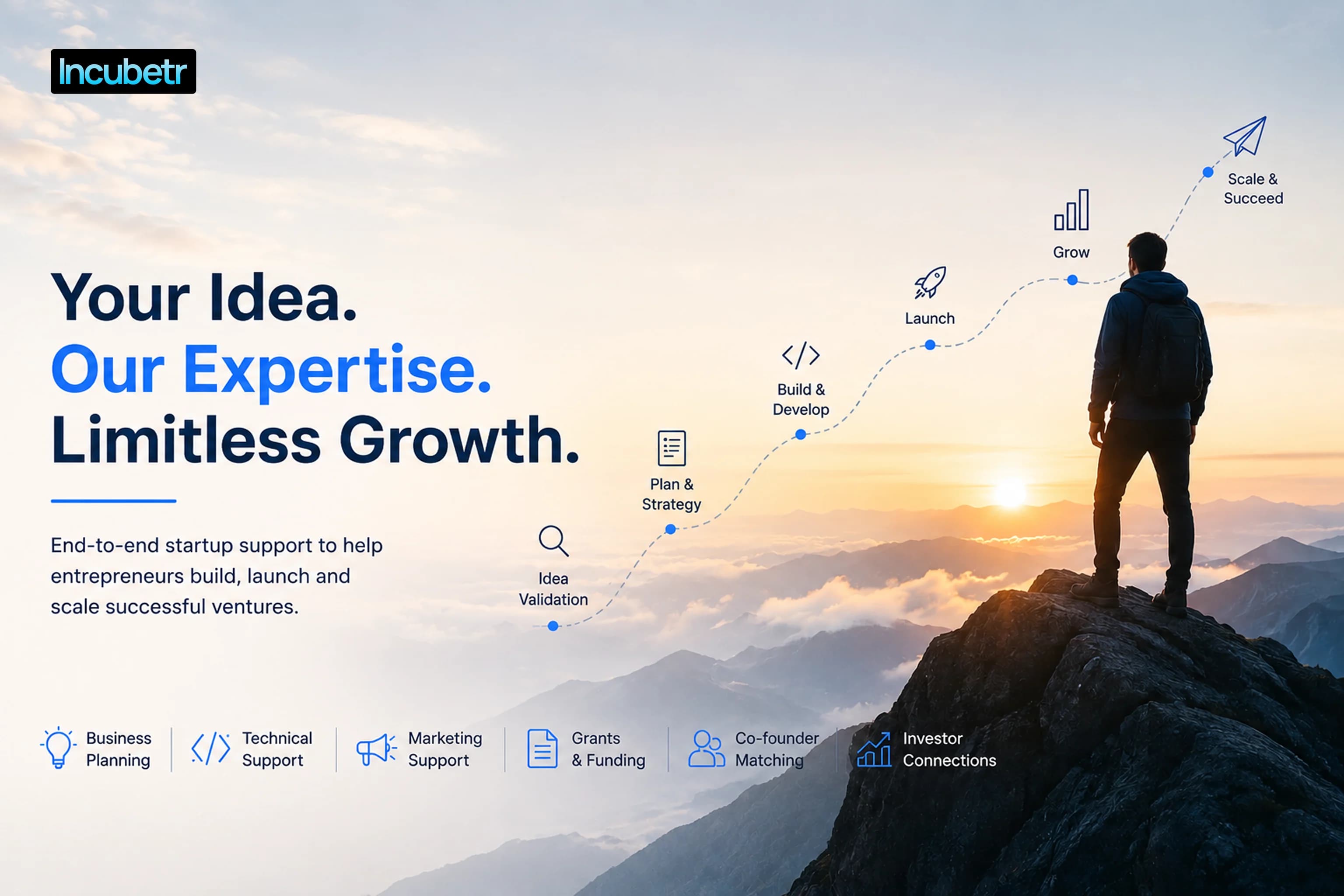
Incubetr exists because of one observation: a startup idea rarely fails at one single moment — it stalls out gradually, one missing piece at a time. So instead of teaching founders about fundraising, grants, or co-founder dynamics, Incubetr does the actual work alongside them, stage by stage:
Idea → Validation → Planning → Building → Launching → Growing → Funding → Scaling
Each arrow in that flow is a place founders commonly get stuck — and each one is a place where having an actual startup roadmap, instead of scattered advice, changes the outcome. If you're not sure your idea has been properly tested yet, our guide on how to validate a startup idea is a good place to start before building anything further.
What Incubetr Helps With at Each Stage
| Stage | Where Founders Usually Get Stuck | How Incubetr Helps |
|---|---|---|
| Idea | Too broad, or never tested against real users | Structured idea validation before you build |
| Validation | Assuming interest instead of confirming it | Customer discovery and real feedback loops |
| Planning | No clear business plan or roadmap | Hands-on business plan development |
| Building | No technical co-founder or dev team | MVP development and technology selection |
| Launching | No go-to-market strategy | Marketing support: positioning, acquisition |
| Growing | Stuck finding the right co-founder | Task-based co-founder matching |
| Funding | Unclear on grants vs. investors | Grant discovery plus investor-facing portfolios |
| Scaling | No investor-ready pitch or projections | Pitch deck support, investor readiness |
Business Planning
Every startup needs a roadmap, even a rough one. A business plan isn't a formality for investors — it's the document that forces you to answer the questions you'd otherwise avoid: who's actually going to pay for this, what it costs to build, and what happens in the first six months if growth is slower than you hoped.
Incubetr works through startup planning with founders directly, instead of handing over a template and wishing them luck — mapping out the roadmap, the numbers, and the milestones specific to their idea. If you'd rather work through this yourself first, our guide on how to write a startup business plan walks through the same structure we use.
Technical Support: Building Your MVP
Most first-time founders aren't developers, and that's usually where things stall — not the idea, but turning it into something real. Technical support means help with technology selection, product architecture, and getting an actual MVP (a Minimum Viable Product — the simplest working version of your idea, built to test whether it works before you spend on anything bigger) into someone's hands to try.
Incubetr works through startup product development with founders directly: choosing the right tech stack, scoping what the first version actually needs, and building toward something you can put in front of real users. For a deeper walkthrough, see how to build an MVP.
Marketing Support
A working product nobody knows exists isn't a startup yet — it's a prototype. Marketing support covers the go-to-market strategy: how you position the product, who your first customers actually are, and how you reach them without burning through your budget guessing.
Incubetr helps founders think through brand positioning and customer acquisition before launch, not after — because the startups that struggle most with marketing are usually the ones that only started thinking about it once the product was already built.
Grant Discovery & Applications
Startup grants can meaningfully extend your runway without giving up equity, but the application process itself is often the real barrier — figuring out which schemes you qualify for, gathering the right documentation, and getting the application in front of the right reviewer.
Incubetr eases this specific process: helping founders discover relevant grants, handling much of the application legwork, and guiding the documentation so approval odds improve — without treating grant approval as guaranteed, since no honest source can promise that. The Indian grant landscape includes government schemes, state-level startup funds, and sector-specific grants, and knowing which category applies to you is most of the battle. Our guide on how startup grants work in India covers this landscape in more depth.
Co-Founder Matching
Finding a co-founder is often harder than finding the idea itself. It's easy to get a compatibility quiz right and still discover, months in, that you and your co-founder handle stress, deadlines, or disagreements completely differently — usually at the worst possible time.
Incubetr's co-founder matching works through a hands-on, human-run process: potential co-founders are given shared tasks and real work to do together before committing to anything, so compatibility shows up through actual collaboration instead of a profile match. Whether it's a technical founder pairing with a business-minded one, the goal is the same — de-risking the decision before equity is on the table. Incubetr's direction over time is to add AI-assisted matchmaking on top of this process, though today it's the human-run trial work doing the heavy lifting. For a deeper look at what to check for, read how to find the right co-founder for your startup.
Investor Readiness
Even a strong startup can struggle to raise if the pitch deck is unclear, the financial projections don't hold up to basic scrutiny, or the founder simply doesn't know which investors are actually a fit for their stage.
Incubetr builds investor-facing portfolios so investors can browse startups directly and reach out if there's a fit — making it easier for the right investors to find and evaluate your startup, rather than promising funding outright. Alongside this, Incubetr helps founders prepare: pitch deck support, cleaning up financial projections, and building a realistic fundraising strategy for their actual stage. See our investor readiness checklist and how investor matching works for early-stage startups for more detail.
Why Choose Incubetr
There's no shortage of resources that teach founders about fundraising, grants, or co-founder dynamics. Incubetr is built around doing that work with founders instead:
- One partner from idea to scale, instead of three separate services to coordinate
- End-to-end startup support across planning, building, marketing, grants, co-founders, and investors
- Expert guidance from people who've actually worked through these problems before
- Personalized strategy instead of a one-size-fits-all template
- A founder-first approach — the plan is built around your idea, not a generic playbook
Who We Help
Incubetr works with people at very different starting points:
- Students with an idea they haven't tested yet
- Working professionals considering a first startup
- First-time founders who don't know where to start
- Experienced entrepreneurs building their next venture
- Startup teams that already exist but are stuck on one specific piece
- Innovators who have the technical skill but not the business side worked out
Our Vision
Incubetr's mission is straightforward: help good ideas become real, sustainable businesses, without founders having to become experts in six unrelated fields just to get there. That means growing India's startup ecosystem one founder at a time — supporting entrepreneurs through the parts of the journey that usually go unsupported, and building toward startup success rooted in real planning and real work, not luck.
FAQs
How do I start a startup with no experience? Start by validating the idea before building anything — talk to potential customers, check if the problem is real, then move into planning. Startup support for entrepreneurs like Incubetr exists specifically to guide first-time founders through this sequence instead of leaving them to guess.
How do I validate a startup idea? Talk to the people who'd actually use it before you build anything. Look for evidence they'd pay for a solution, not just polite interest. Our guide on how to validate a startup idea walks through this in detail.
How do I find a co-founder I can actually trust? Work on something small and real together before committing — shared tasks reveal how someone handles pressure, disagreement, and deadlines far better than a conversation does.
How do I get startup funding as a first-time founder? Most first-time founders combine early grants with investor funding later, once there's some traction. Getting investor-ready — a clear pitch deck, realistic projections — usually matters more at this stage than the pitch itself.
How do I apply for startup grants in India? Identify which schemes actually match your sector and stage, then prepare documentation carefully — most rejected applications aren't rejected for the idea, but for incomplete or mismatched paperwork.
What makes a good startup support company? Look for support that covers the full journey — planning, building, marketing, grants, co-founders, and investors — rather than one narrow service, and one that's upfront about what it can and can't guarantee.
Conclusion
A good idea is the easy part. What actually determines whether it becomes a startup — or stays a notebook sketch — is whether someone helps you handle the planning, the building, the marketing, the grants, the co-founder decision, and the investor conversations, instead of leaving you to figure out all six alone.
If you're ready to move your idea forward, validate your idea, start building your business plan, or connect with Incubetr directly to talk through where you're stuck.