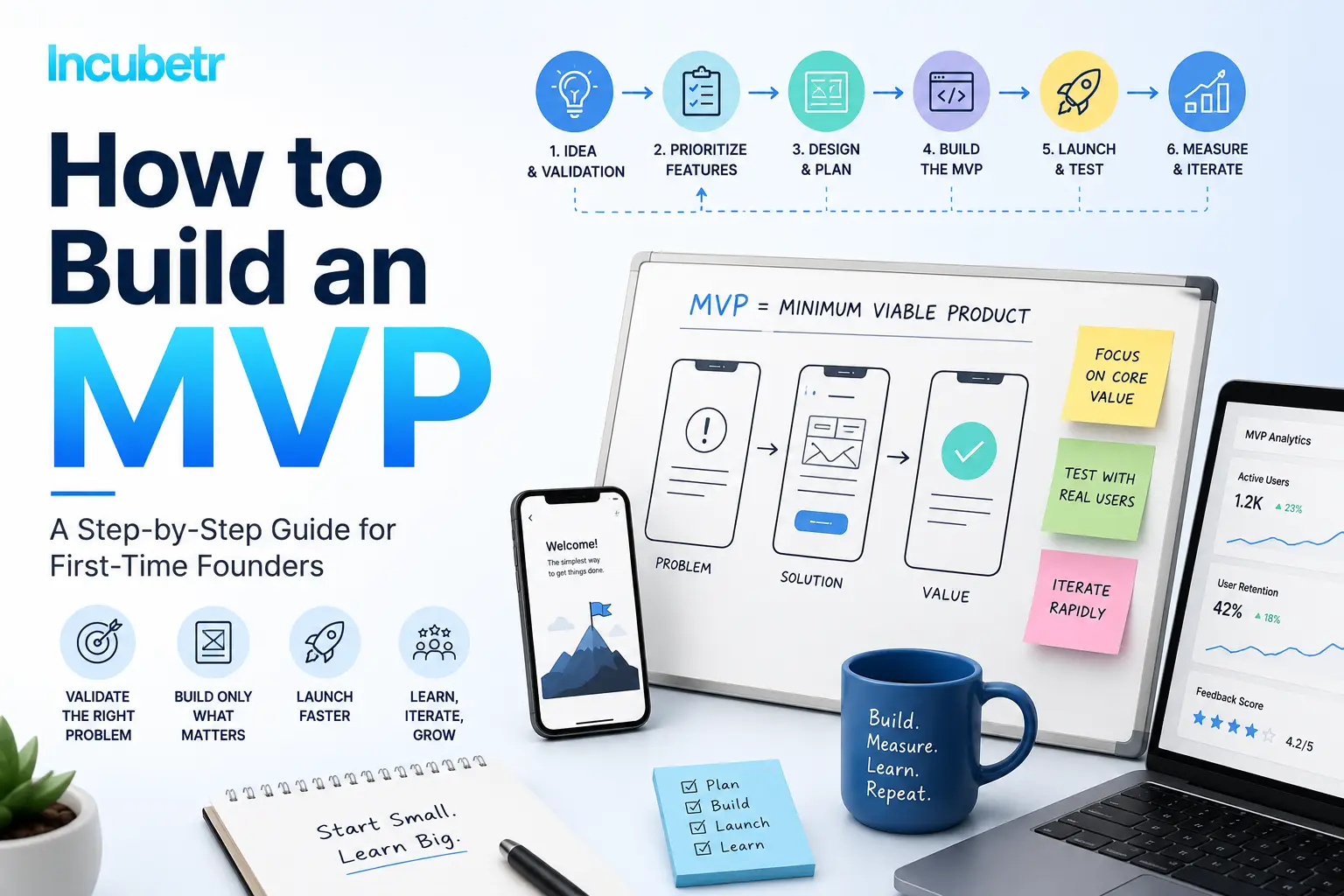
How to Build an MVP: A Step-by-Step Guide for First-Time Founders
Incubetr Team
·22 July 2026
How to Build an MVP: A Step-by-Step Guide for First-Time Founders
Most founders build too much. They spend six months on a feature list nobody asked for, then launch to silence. Successful founders do the opposite — they build just enough to find out if anyone actually wants what they're making, then improve from there.
That's the whole idea behind an MVP. If you already have a validated problem and a business plan, this guide covers how to build an MVP without wasting the months and money most first-time founders lose figuring this out the hard way.
This guide draws heavily on Lean Startup and Agile thinking — small, testable increments instead of a long, unverified build. Every step below exists to get you to real user feedback as fast as possible, because that feedback is worth more than any amount of internal debate about what customers 'probably' want.
Table of Contents
- What Is an MVP?
- Prototype vs. MVP vs. Full Product
- Why Every Startup Needs an MVP
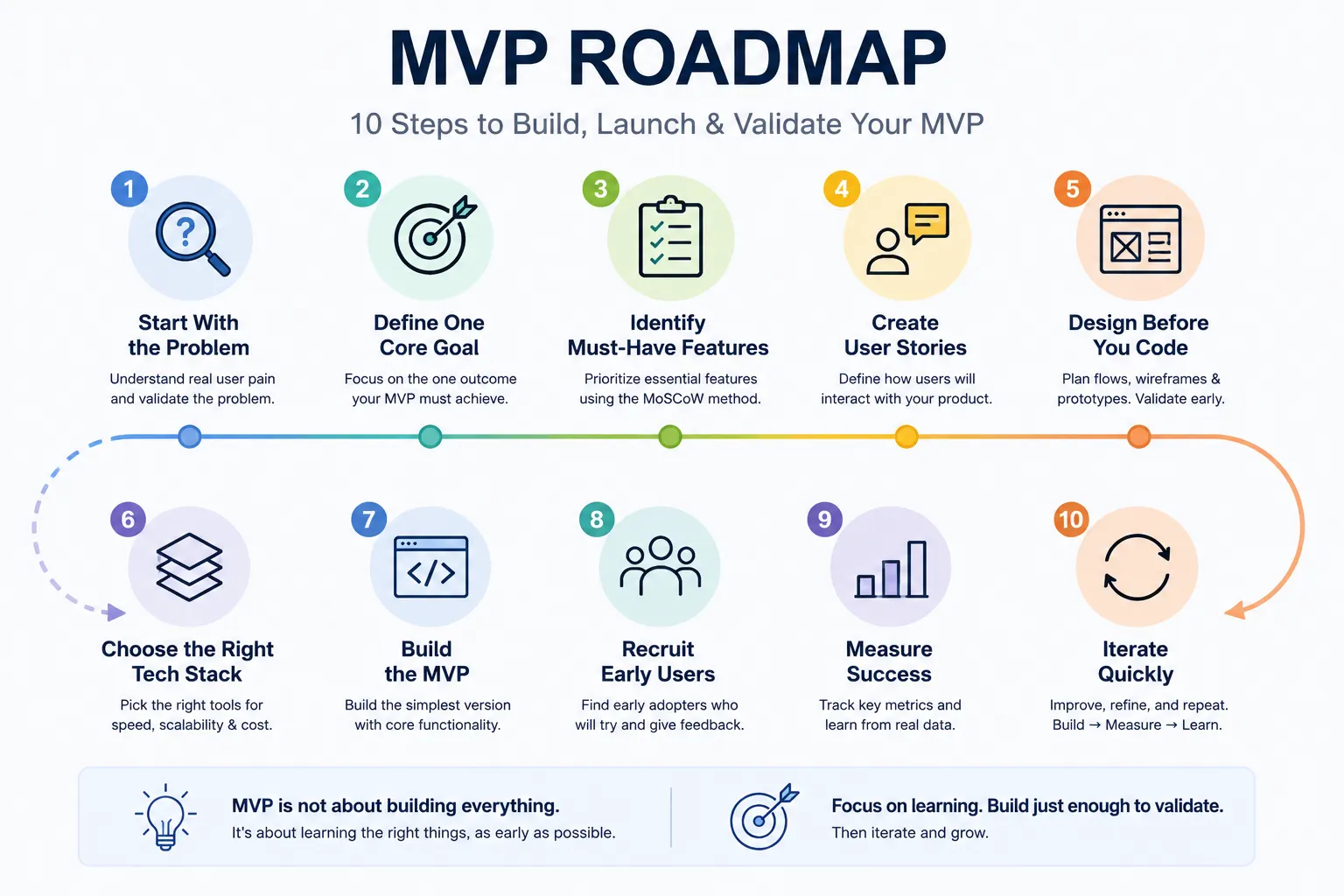
- Step 1: Start With the Problem
- Step 2: Define One Core Goal
- Step 3: Identify Must-Have Features
- Step 4: Create User Stories
- Step 5: Design Before You Code
- Step 6: Choose the Right Tech Stack
- Step 7: Build the MVP
- Step 8: Recruit Early Users
- Step 9: Measure Success
- Step 10: Iterate Quickly
- From MVP to Product-Market Fit
- Build vs. Buy vs. No-Code
- Common MVP Mistakes
- MVP Launch Checklist
- FAQs
- Final Thoughts
What Is an MVP?
An MVP isn't a half-finished product you're embarrassed to ship. It's the smallest version of your idea that actually proves people want the solution — nothing more, nothing less.
A few well-known examples show how minimal a real MVP can be:
- Dropbox launched with an explainer video demonstrating file syncing, before the underlying technology was fully built, purely to measure signup interest.
- Airbnb's founders rented air mattresses in their own apartment to conference attendees, testing demand long before there was a platform or an app.
- Buffer validated its scheduling tool with a landing page and a pricing page, checking whether people would actually pay before writing the product.
- Zappos' founder famously tested online shoe sales by photographing shoes from local stores and manually buying and shipping them to customers who ordered, before building any real inventory system.
None of these looked impressive. All of them answered the one question that matters: will people actually use or pay for this?
The common thread across all four examples is that the founders deliberately avoided building the hardest, most expensive part of the product first. Dropbox didn't build a full file-syncing engine before testing interest. Zappos didn't build a warehouse before testing whether people would buy shoes online. In each case, the 'product' was really just enough infrastructure to generate an honest yes-or-no answer from real customers.
Prototype vs. MVP vs. Full Product
It's worth being precise about these three terms, since founders often use them interchangeably:
| Prototype | MVP | Full Product | |
|---|---|---|---|
| Purpose | Test design and flow | Test real usage and demand | Serve the full market |
| Functional? | Usually not (clickable mockup) | Yes, for the core action | Yes, fully |
| Audience | A handful of test users | Early adopters | General market |
| Investment | Hours to days | Weeks | Months to years |
A prototype answers 'does this make sense to a user?' An MVP answers 'will real people actually use or pay for this?' A full product is what you build once both of those questions already have a confident yes behind them.
Why Every Startup Needs an MVP
- Lower cost — you spend weeks, not months, before finding out if the idea holds up
- Faster launch — a smaller scope means you can put something in front of real users sooner
- Real feedback — actual usage data beats any amount of speculation about what people want
- Easier fundraising — early traction, even modest, is a fundamentally stronger pitch than a plan alone
- Less risk — you're testing your core assumption before betting the whole budget on it
- Faster iterations — a smaller product is easier to change quickly as you learn
Taken together, these benefits point at one underlying idea: an MVP trades a small amount of upfront polish for a large amount of early certainty. Most founders who skip this trade end up paying for it later, in the form of a fully built product nobody wanted enough to keep using.
Step 1: Start With the Problem
An MVP built on an unvalidated problem is just a smaller version of the same mistake. Before scoping anything, you should already have clear answers on who has this problem, how painful it is, and whether they're already paying for a workaround. If you haven't worked through this yet, our guide on how to validate a startup idea covers exactly this groundwork — and the business plan you build afterward, covered in how to write a startup business plan, should already point toward what this MVP needs to prove.
Specifically, go back to your customer interviews and pull out the single sentence that describes the core pain most consistently. That sentence — not a feature list, not a competitor's product — is what your MVP scope should trace back to. If a feature you're considering doesn't clearly serve that sentence, it's a candidate to cut, regardless of how easy it would be to build.
Step 2: Define One Core Goal
Don't try to solve everything in version one. Every successful product started by nailing a single core action:
- Uber — book a ride
- Dropbox — sync files
- Instagram — share photos
Pick the one action that, if it worked well, would prove your idea has legs. Everything else is secondary until that core action is validated.
A useful test for whether you've actually found the core goal: could you describe your entire MVP in one sentence, using a verb and a single object? 'Let a rider book a ride' passes. 'A platform that helps people manage their lives better' does not — it's too broad to build, and too broad to measure success against.
Step 3: Identify Must-Have Features
The MoSCoW framework — Must have, Should have, Could have, Won't have — is a simple way to separate what actually belongs in an MVP from what can wait.
| Priority | Example Feature | Included in MVP? |
|---|---|---|
| Must have | Core action (e.g., book a ride) | Yes |
| Must have | Basic authentication | Yes |
| Should have | Push notifications | Not yet |
| Could have | Referral program | Not yet |
| Won't have (for now) | Multi-language support | No |
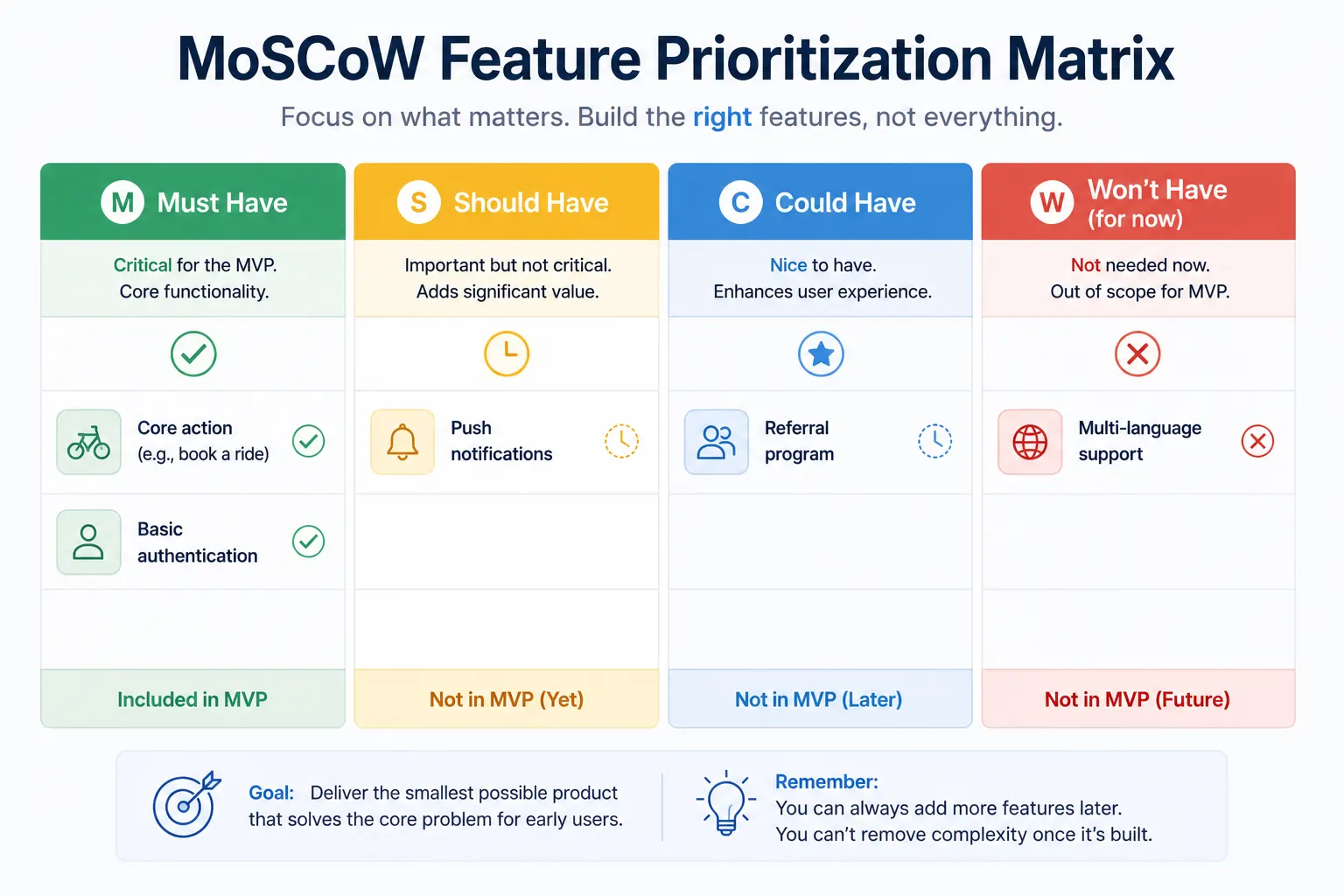
A good MVP scope usually has more items in 'Won't have' than in 'Must have' — that's a sign you're actually being disciplined about scope, not a sign you're under-building.
If you have several 'Must have' candidates competing for limited time, the RICE framework — scoring each feature on Reach, Impact, Confidence, and Effort — can help break the tie. A feature that touches every user, meaningfully improves their experience, that you're confident about, and that's cheap to build scores highest; a feature that only helps a narrow segment and takes weeks to build should usually wait, even if it feels important in the moment.
Step 4: Create User Stories
Once you know the core action, translate it into user stories using a simple format:
As a [type of user], I want [goal], so that [benefit].
For example: 'As a first-time rider, I want to book a ride in under a minute, so that I don't have to call a cab company and wait on hold.' Writing features this way keeps the team focused on the outcome for the user, not just a checklist of screens to build.
A few more examples across different products:
- 'As a busy freelancer, I want to send an invoice in two taps, so that I get paid faster without extra admin work.'
- 'As a new user, I want to see results within seconds of signing up, so that I trust the product enough to keep using it.'
Each story should map back to one of your Must-have features from Step 3. If you can't write a clear user story for a feature, that's often a sign the feature isn't as essential as it seemed.
Step 5: Design Before You Code
Design the experience before writing any code. This step is cheap to change and expensive to skip:
- Wireframes — rough sketches of each screen's layout, often in Figma
- User flow — the sequence of screens a user moves through to complete the core action
- Clickable prototypes — a tappable, non-functional version you can test with real users before building anything
A prototype is not an MVP — it's a rehearsal for one. Testing a clickable prototype with five to ten early users before writing code is one of the highest-leverage hours you'll spend in this whole process.
Watch for where people hesitate or get confused while clicking through the prototype — that hesitation almost always shows up again, more expensively, once the same confusion is baked into working code. It's far cheaper to redesign a Figma screen than to rebuild a feature that's already been shipped.
Step 6: Choose the Right Tech Stack
Your tech choice should match your stage, not your ambitions. Broadly:
- No-code (Bubble, FlutterFlow, Webflow) — fastest to launch, best when you're still validating and don't yet need deep customization or scale
- Low-code — a middle ground, faster than custom development with more flexibility than pure no-code, useful once you know roughly what you're building but still want speed
- Traditional/custom development (React, Flutter, Next.js, Go, Node, Firebase, Supabase) — slower to start but necessary once you need real scalability, custom logic, or tight integrations that no-code platforms can't handle
Most first-time founders overestimate how much custom development they need on day one. If your core hypothesis can be tested on a no-code platform, that's usually the faster and cheaper path to a real answer.
| Stack Type | Time to Launch | Typical Cost | Best When |
|---|---|---|---|
| No-code (Bubble, FlutterFlow, Webflow) | Days to a few weeks | Lowest | You're still testing whether the core idea works at all |
| Low-code | A few weeks | Moderate | The core idea is validated, but you need some custom logic |
| Custom (React, Flutter, Next.js, Go, Node, Firebase, Supabase) | Weeks to months | Highest | You have proven demand and need real scale, performance, or unique integrations |
Many successful startups migrate from no-code to custom development after validation, not before — it's a perfectly normal sequence, not a sign of an earlier mistake. Rebuilding on custom infrastructure once you have real traction is a good problem to have; it means the earlier, faster choice already did its job.
Step 7: Build the MVP
Focus the build entirely on:
- The core workflow — the one action from Step 2, working reliably
- Authentication — just enough to identify real users
- Payments — only if your core hypothesis actually requires testing willingness to pay
- Basic analytics — enough to see what users are actually doing
Don't polish. Rough edges in an MVP are expected and even useful — they tell you where real users get confused, which is exactly the feedback you're trying to collect.
Set a hard deadline for this stage, even an imperfect one. Founders who leave the build phase open-ended tend to keep adding 'just one more feature' indefinitely — the deadline itself is often the thing that forces the discipline your MoSCoW list was supposed to enforce.
Step 8: Recruit Early Users
Your first users should come from people who've already shown interest — your validation waitlist, interview list, or relevant online communities. Cold, untargeted signups at this stage tend to produce noisy, unreliable feedback, since many of them never had the underlying problem in the first place.
- Waitlist and email list from your validation stage
- Relevant communities — subreddits, Discord servers, or Facebook groups where your target persona already spends time
- LinkedIn — especially effective for B2B ideas
- Cold outreach — direct messages to people who match your exact target persona
Early adopters recruited this way tend to be more forgiving of rough edges and more generous with detailed feedback than users you'd get from broader marketing later.
Aim for a specific, small number rather than a vague 'as many as possible' — twenty to fifty genuinely engaged early users who match your persona closely will teach you more than a thousand signups pulled in by a broad ad campaign with no real connection to the problem you're solving.
Step 9: Measure Success
Once real users are in, track what they actually do, not just how many signed up. Vanity metrics like total signups feel reassuring but rarely predict whether the business will actually work — the numbers below do:
- Activation — do new users reach the core action quickly?
- Retention — do they come back?
- Usage and session length — are they engaging meaningfully, or just glancing and leaving?
- Conversion — do free users convert to paying, if that's your model?
- Revenue — is anyone actually paying, and does it hold at your intended price?
- Referrals — are users telling other people about it unprompted?
Don't wait for a large sample size before looking at these numbers. Even with twenty active users, a pattern of people not returning after their first session is a meaningful signal worth acting on, not something to dismiss as 'too early to tell.'
Step 10: Iterate Quickly
The loop that carries you from here forward is simple and constant: Build → Measure → Learn → Improve → Repeat.
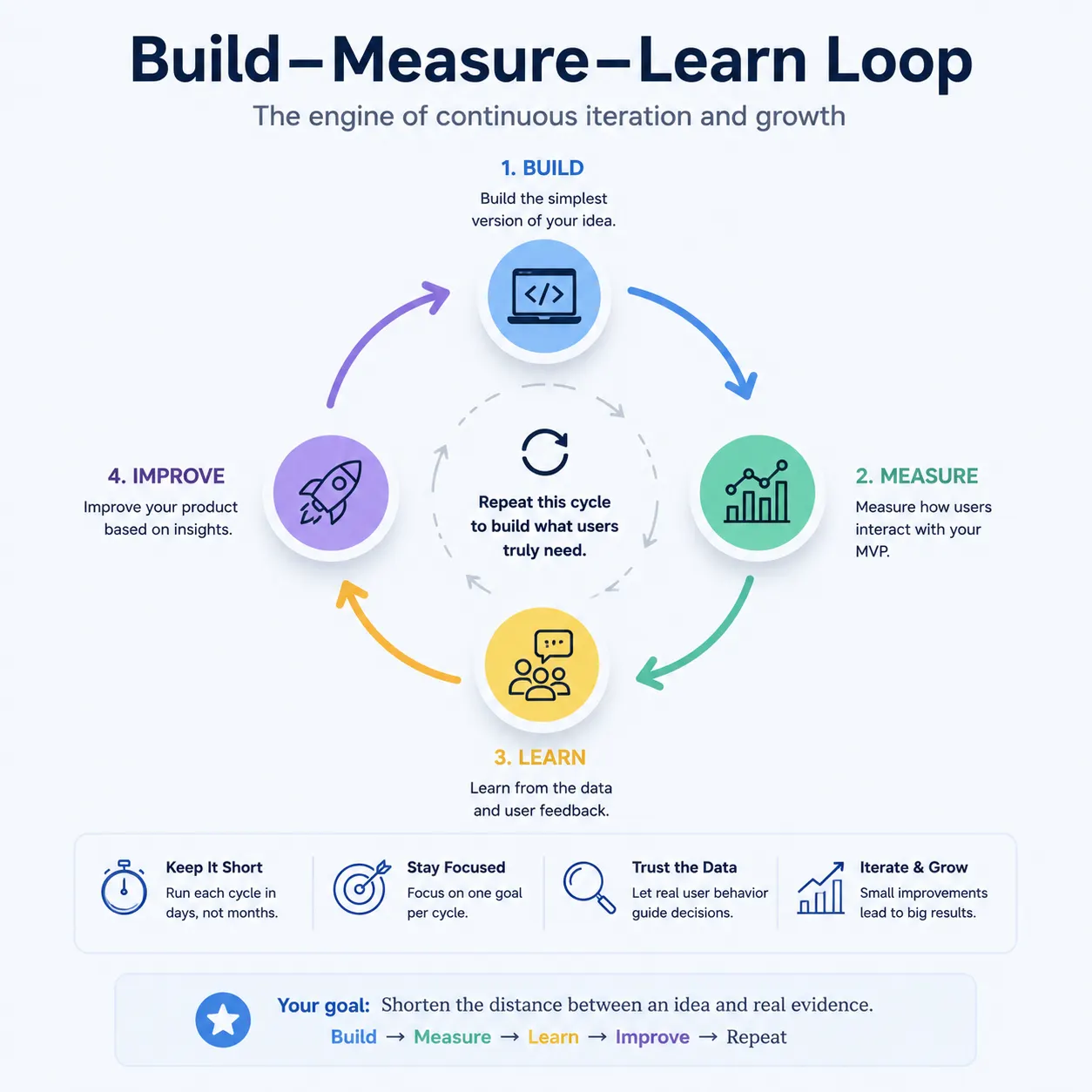
Each cycle should be short — days or a couple of weeks, not months. The goal of an MVP was never to get it right the first time; it's to shorten the distance between an idea and real evidence about whether it works.
From MVP to Product-Market Fit
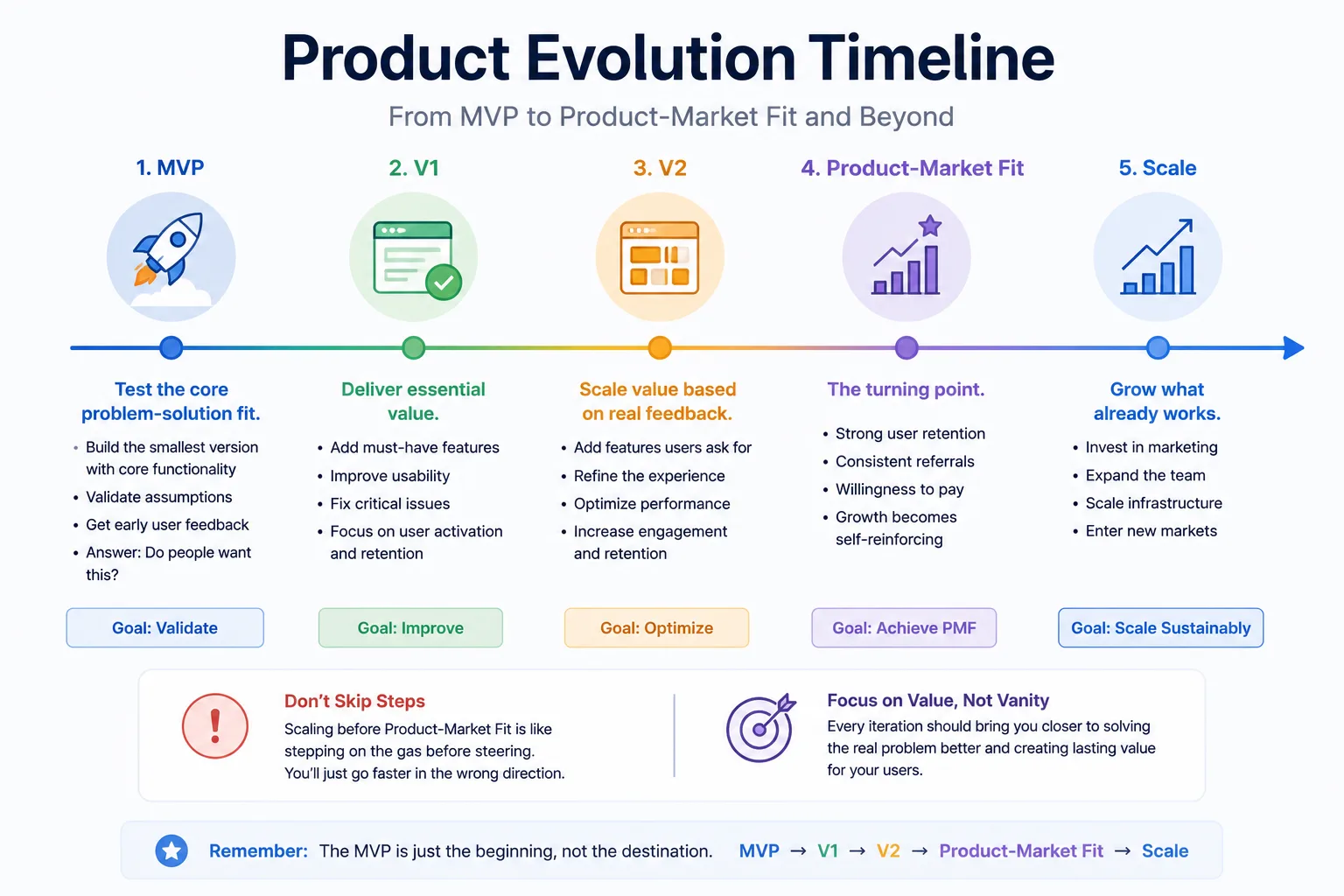
It helps to see where the MVP actually sits in a longer arc, so you don't mistake it for the finish line:
MVP → V1 → V2 → Product-Market Fit → Scale
The MVP tests whether the core problem-solution fit is real. V1 and V2 add the features your early users actually asked for, based on real usage rather than the original wish list. Product-market fit is the point where retention, referral, and revenue signals all start reinforcing each other rather than fighting for attention. Only after that does 'scale' — more marketing spend, a bigger team, more infrastructure — actually make sense. Skipping straight to scale before product-market fit is one of the more expensive mistakes a founder can make, because it accelerates growth in a direction that hasn't been proven yet.
Build vs. Buy vs. No-Code
| Approach | Speed | Cost | Flexibility | Best For |
|---|---|---|---|---|
| No-code | Fastest | Lowest | Limited | Early validation, simple workflows |
| Low-code | Fast | Moderate | Moderate | Validated ideas needing some customization |
| Custom development | Slowest | Highest | Highest | Proven demand, need for scale or unique tech |
There's no universally 'right' choice here — the right one depends entirely on how confident you already are in the idea and how much customization your core workflow actually needs.
Common MVP Mistakes
- Building every feature instead of just the core action
- Hiring a large team too early, before there's a product to justify it
- Ignoring users once the MVP is live, instead of watching what they actually do
- Perfectionism — polishing an MVP delays the feedback that would tell you what's actually worth polishing
- No analytics, so you're guessing at usage instead of measuring it
- Launching too late, past the point where the MVP could still be considered minimal
- Ignoring feedback that contradicts what you hoped to hear
Of these, perfectionism and ignoring feedback are the two that quietly kill the most promising ideas — not because the idea was wrong, but because the founder never let real evidence override their original assumptions.
MVP Launch Checklist
✔ Customer and problem validated ✔ Features prioritized (MoSCoW) ✔ Wireframes complete ✔ Prototype tested with real users ✔ MVP built ✔ Analytics installed ✔ Feedback channel ready ✔ Waitlist prepared ✔ Launch plan created
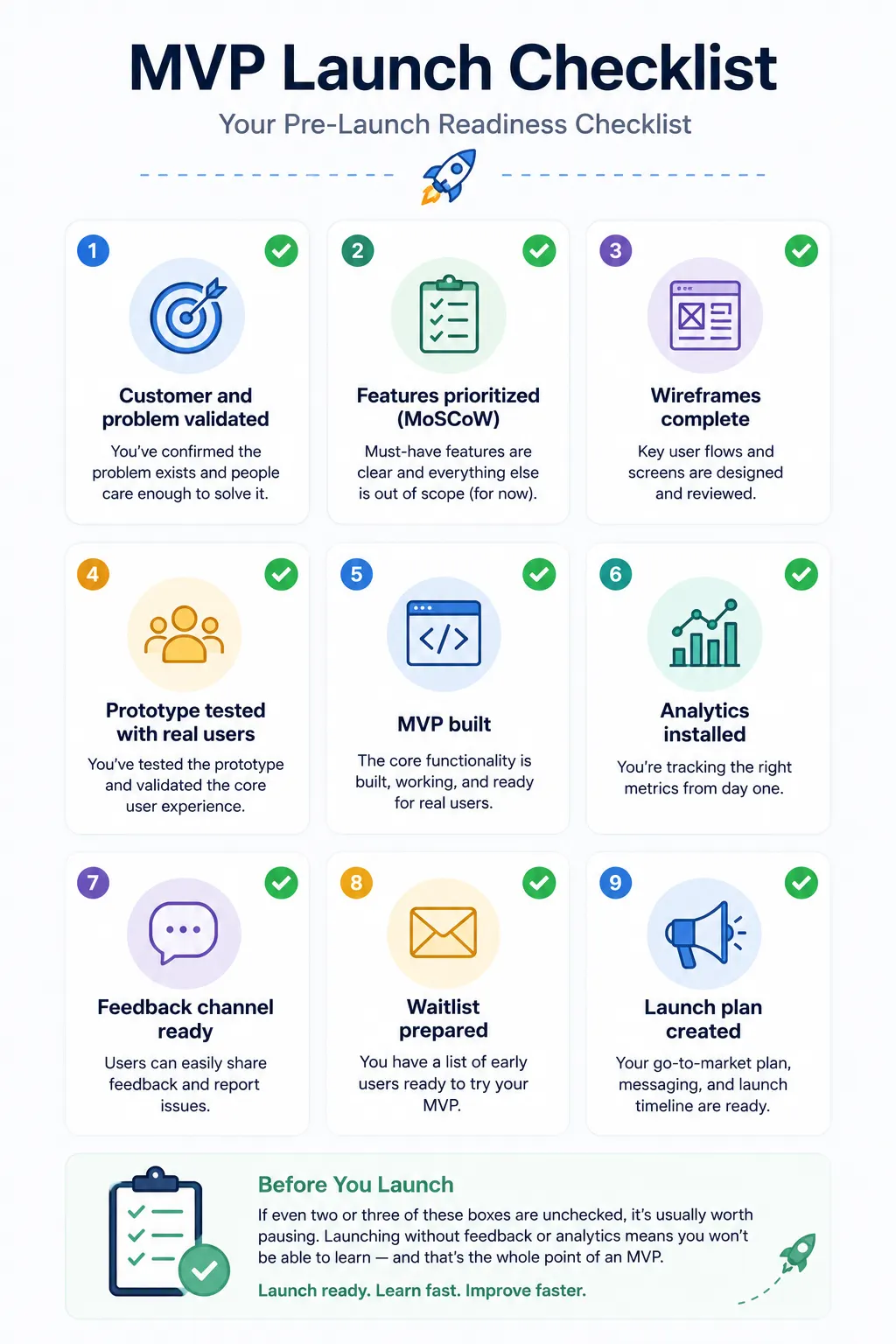
If even two or three of these boxes are unchecked, it's usually worth pausing rather than launching anyway — a missing feedback channel or missing analytics setup means you'll launch without the ability to actually learn from what happens next, which defeats the purpose of building an MVP in the first place.
FAQs
How long does it take to build an MVP? Most lean MVPs take anywhere from a few weeks to two or three months, depending on scope and tech stack — a no-code MVP testing one core action can often launch in weeks, while custom development for a more complex workflow takes longer.
How much does an MVP cost? Costs vary widely based on complexity and whether you use no-code tools, freelancers, or a dedicated development team — the more disciplined your MoSCoW scoping, the lower the cost tends to be, since scope is usually the biggest cost driver.
How do I build an MVP without coding? No-code platforms like Bubble, FlutterFlow, and Webflow let you build a working MVP for many workflows without writing code, which is often the fastest way to test a core hypothesis before investing in custom development.
What's the difference between a prototype and an MVP? A prototype is a clickable mockup used to test a design or flow before building anything real; an MVP is an actual working product real users can use, even if the underlying functionality is minimal.
What are some well-known MVP examples? Dropbox's explainer video, Airbnb's air-mattress test, Buffer's landing page, and Zappos' manually-fulfilled shoe orders are all commonly cited examples of testing demand before building the full product.
How do I know when my MVP is ready to launch? When the core action from Step 2 works reliably end to end, even if everything around it is rough — a launch-ready MVP is defined by whether the one thing it needs to prove actually works, not by how polished it looks.
Should I use Agile or Scrum to build my MVP? Small teams often borrow just the useful parts of Agile — short sprints and frequent check-ins — without adopting the full formal Scrum process, which tends to add more overhead than a two- or three-person founding team needs at this stage.
Final Thoughts
An MVP isn't Version 1 — it's Version 0.1. The goal was never to impress investors with a polished product on day one; it's to learn faster than your competitors about what customers actually want. If you're figuring out how to build an MVP right now, resist the urge to build more than the one thing you need to test, and let real user feedback tell you what to build next.
The founders who struggle most with this stage usually aren't the ones who lack technical skill — they're the ones who can't resist adding 'just one more feature' before they'll let anyone see it. Treat that instinct as the signal to stop, not to keep going.
Building the right MVP is about making the right decisions before writing thousands of lines of code. At Incubetr, we help founders define MVP scope, prioritize features, choose the right technology stack, build scalable products, and prepare for growth — so you can validate faster with less risk. Explore how to find a co-founder, the startup grants guide, our startup marketing guide, or the investor readiness checklist for what comes after your MVP is live.