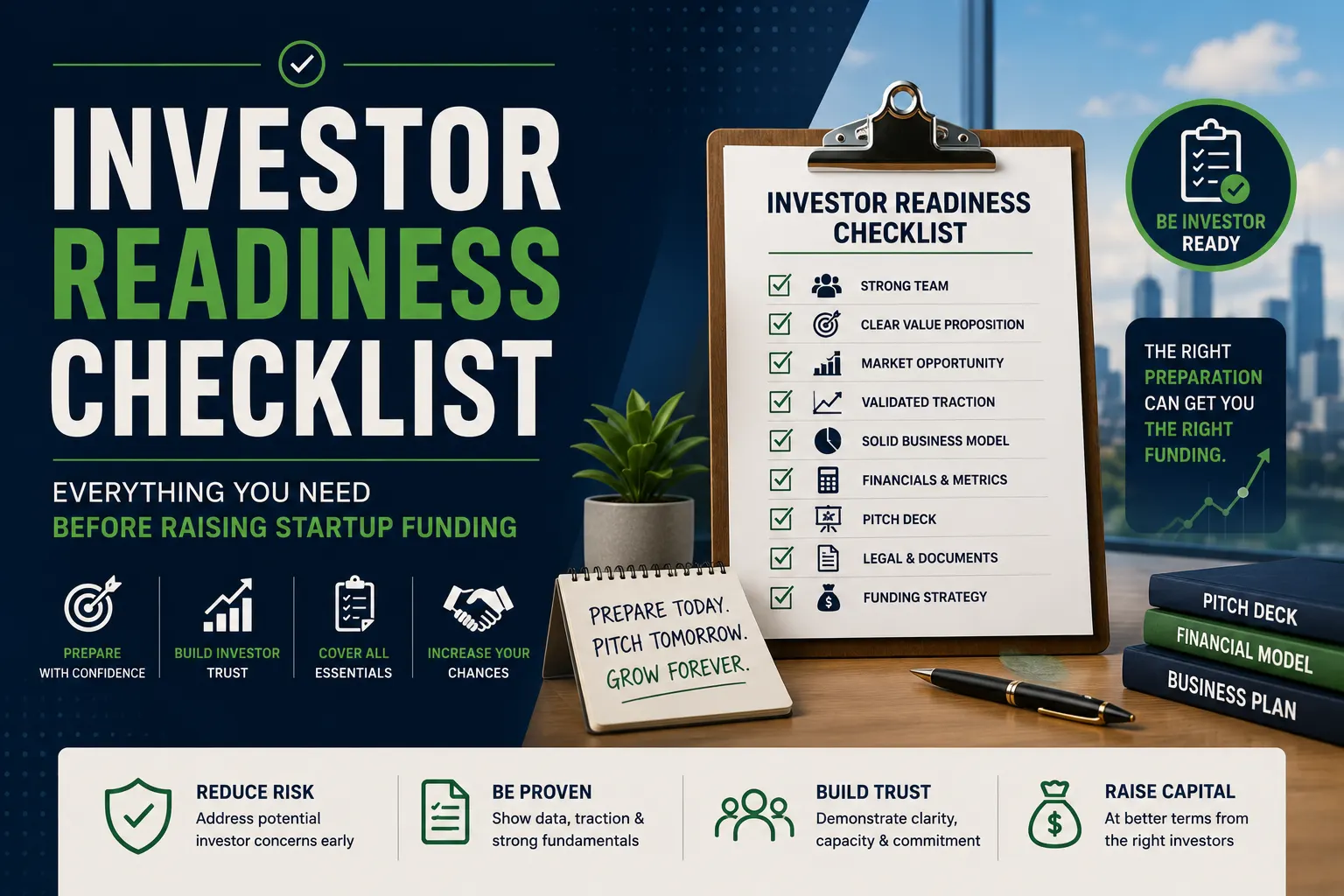
Investor Readiness Checklist: Everything You Need Before Raising Startup Funding
Incubetr Team
·22 July 2026
Investor Readiness Checklist: Everything You Need Before Raising Startup Funding
A common misconception trips up first-time founders: raising funding starts long before your first investor meeting. By the time you're in that room, the real work — building evidence, not just enthusiasm — should already be mostly done.
Investors aren't investing in ideas. They're investing in validated businesses with evidence: real customers, real usage, real numbers, and a team that's demonstrated it can execute. This investor readiness checklist exists to help you identify and close those gaps before you start pitching, rather than discovering them mid-conversation with a term sheet on the line.
Many founders treat fundraising as a single event to prepare for over a few weeks. In practice, the founders who raise most smoothly have usually been building toward readiness for months, sometimes without explicitly framing it that way — every customer interview, every retention metric tracked, and every clean financial record is part of the same preparation this checklist lays out.
Table of Contents
- What Does Investor Readiness Mean?
- When Should You Start Raising Funding?
- Investor Readiness Checklist
- Investment Readiness Wheel
- Angel Investors vs. Seed Funds vs. Venture Capital
- What Investors Actually Look For
- Metrics Investors Care About
- Common Mistakes Before Fundraising
- Investor Due Diligence Checklist
- Downloadable Investor Readiness Checklist
- FAQs
- Final Thoughts
What Does Investor Readiness Mean?
Investor readiness isn't a single milestone — it's evidence across four questions investors are quietly asking throughout every conversation:
- Is there a real problem? Not a hypothetical one, but one you can show people actually experience and want solved.
- Do customers want this specific solution? Interest is one thing; usage, retention, or payment is stronger proof.
- Can this team execute? Founders who've shipped, learned, and adjusted quickly are a safer bet than a strong idea paired with an unproven team.
- Can the business actually scale? A solution that works for ten customers needs a credible path to working for ten thousand.
A startup doesn't need a perfect answer to all four before raising — but weak or missing answers to more than one should be treated as a signal to close that gap first, not to compensate for it with a better pitch deck.
It's worth being honest with yourself about which of these four is genuinely weakest right now. Founders often assume their weak spot is the pitch deck or the financial model, when the real gap is usually earlier — thin customer validation or a team that hasn't yet shown it can ship reliably. A polished deck can't cover for missing evidence; it can only present the evidence you actually have more clearly.
When Should You Start Raising Funding?
A few honest indicators that it's time, rather than premature:
- Your MVP is launched and being used by real people, not just planned
- You have early traction — even modest, but real and trending upward
- You have paying customers, or at minimum strong validation signals if the model doesn't monetize from day one
- You have a clear growth strategy, not just a product that works
- You need capital specifically to accelerate something already working — not to fund figuring out whether the idea works at all
A simple decision flow: if you're still validating the core problem, raising now is premature — work through our guide on how to validate a startup idea first. If you have an MVP but no real usage yet, focus on getting genuine early traction before fundraising conversations. If you have real traction and a specific, capital-intensive next step (hiring, marketing spend, geographic expansion), that's usually the right moment to start preparing.
Raising too early is a more common and more expensive mistake than raising slightly too late. A startup that raises before it has real evidence often ends up with a valuation it can't grow into, an investor base expecting a pace of progress the business isn't ready for, and pressure to spend capital before it's clear what actually works. Waiting a few extra months to build genuine traction usually leads to a faster, cleaner raise on better terms than rushing in early.
The Startup Funding Journey
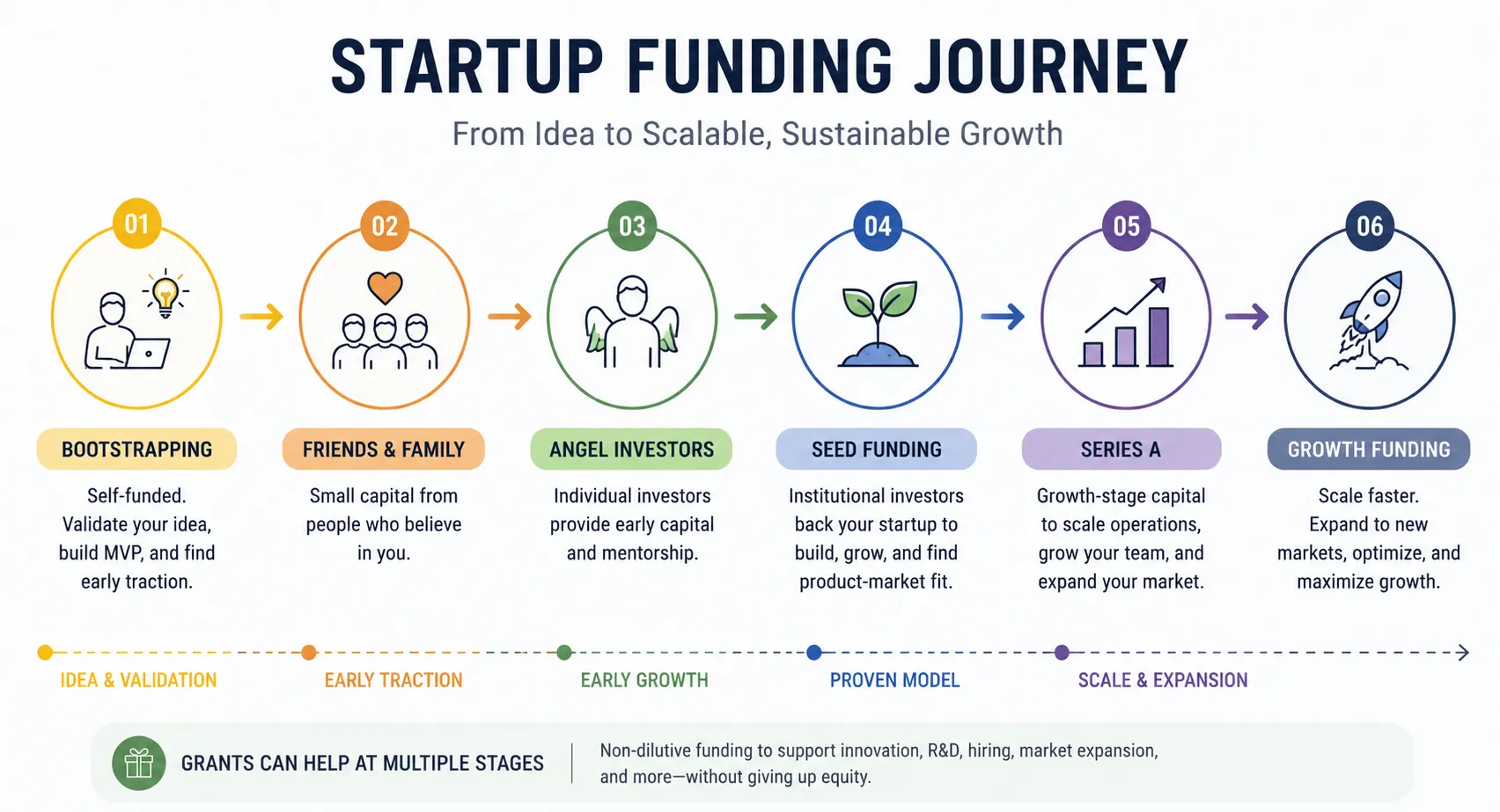
Most startups move through a rough sequence: bootstrapping (self-funded, often alongside validation) → friends and family (small, early capital from personal networks) → angel investors (individual early-stage backers) → seed funding (institutional early-stage capital) → Series A (growth-stage capital once the model is proven) → growth funding (scaling an already-working business further). Not every startup passes through every stage, and grants covered in our startup grants guide can supplement several of these stages without diluting equity. Knowing where you actually sit on this path helps set realistic expectations for who you should be talking to right now.
Fundraising Preparation Timeline
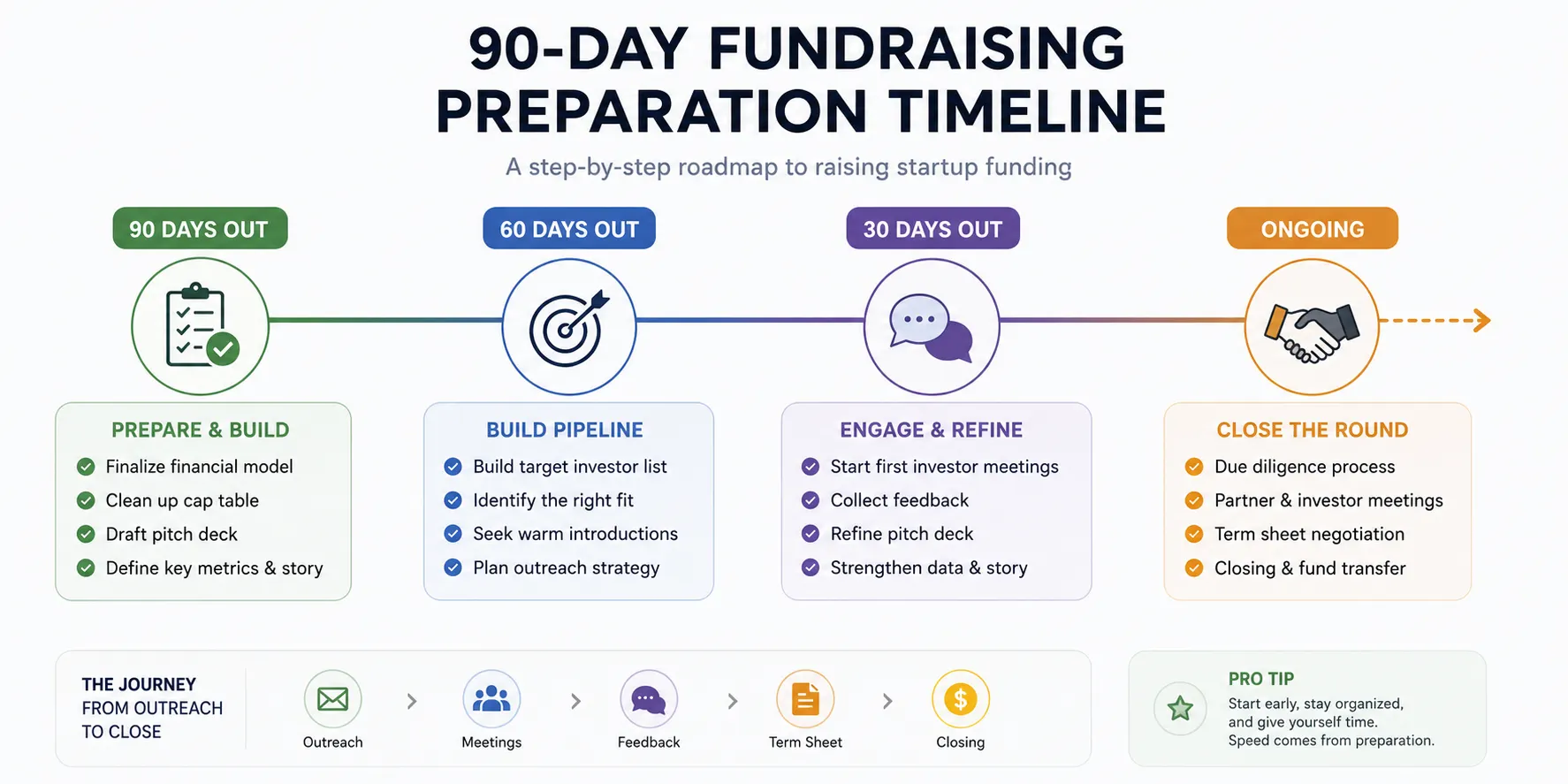
A realistic preparation timeline, working backward from a target close:
- 90 days out — finalize financial model, clean up the cap table, and start drafting the pitch deck
- 60 days out — build your target investor list and start warm introductions where possible
- 30 days out — begin first meetings, gather feedback, and refine the deck based on real questions you're getting
- Ongoing — due diligence, partner meetings, term sheet negotiation, and finally closing
Most first-time founders underestimate how long this entire process takes — a raise that closes in under three months from first outreach is faster than average, not the typical case.
Investor Readiness Checklist
This is the core of the guide — work through each category honestly, and treat any gap as something to close before your first serious investor conversation, not something to gloss over in the pitch.
✅ Problem Validation
- Customer interviews completed
- Market research conducted
- Clear, specific pain point defined
- Early product-market fit signals emerging
✅ Product
- MVP launched
- Product reasonably stable, not breaking under normal use
- User feedback actively collected and reviewed
- Product roadmap defined for the next two to three quarters
✅ Customers
- Active users, tracked consistently
- Paying customers, or a credible near-term path to them
- Testimonials from real users
- Retention metrics you can show, not just describe
- Early referral data, even informal
✅ Business Model
- Revenue model clearly defined
- Pricing tested with real customers, not just assumed
- Unit economics understood — what it costs to acquire and serve a customer, versus what they're worth
- Customer acquisition strategy documented, not just 'we'll figure out marketing later'
✅ Financials
- Revenue forecast, grounded in real assumptions
- Expense forecast covering the next 12–18 months
- Burn rate calculated and monitored monthly
- Runway known precisely, not roughly estimated
- Cash flow tracked
- Break-even estimate, even if it's still some distance away
✅ Pitch Deck
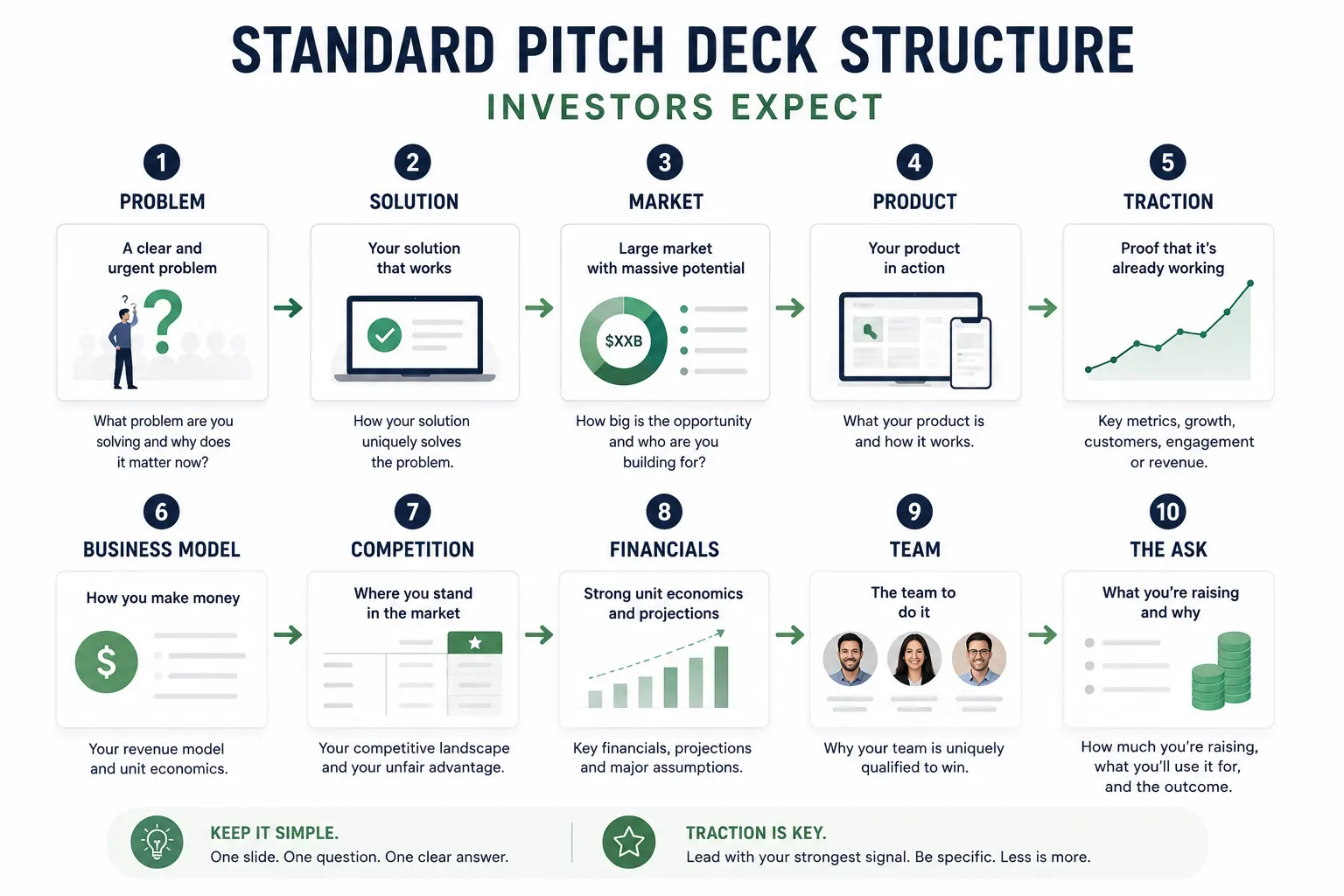
A strong deck covers, in roughly this order: problem, solution, market, product, traction, business model, competition, financials, team, and the ask. Each slide should answer one question clearly rather than trying to cover several at once.
The traction slide deserves particular care — it's often the one investors linger on longest. Whatever your strongest evidence is (revenue growth, retention, a notable customer, a compelling engagement metric), that should be presented plainly and specifically, rather than buried among several weaker data points that dilute the strongest signal you actually have.
✅ Legal & Documentation
- Company properly incorporated
- Founders' agreement in place
- Cap table current and accurate
- IP ownership clearly assigned to the company, not sitting with an individual founder
- NDAs in place where genuinely relevant
- Financial statements available and organized
Of these, a messy or out-of-date cap table is the single most common surprise founders run into during due diligence — small early equity promises made informally to advisors or early hires have a way of resurfacing at exactly the wrong moment if they were never properly documented.
✅ Team
- Founders with complementary skills, not three people with the same strengths
- Advisors who add credibility or fill a real gap, not just recognizable names
- A hiring roadmap showing what roles come next and why
✅ Go-To-Market Strategy
- Customer acquisition channels identified and tested, not just theorized
- Marketing strategy documented — see our startup marketing guide for the full framework
- Sales process defined, even if still largely founder-led
- A believable growth plan for the next funding stage
✅ Fundraising Strategy
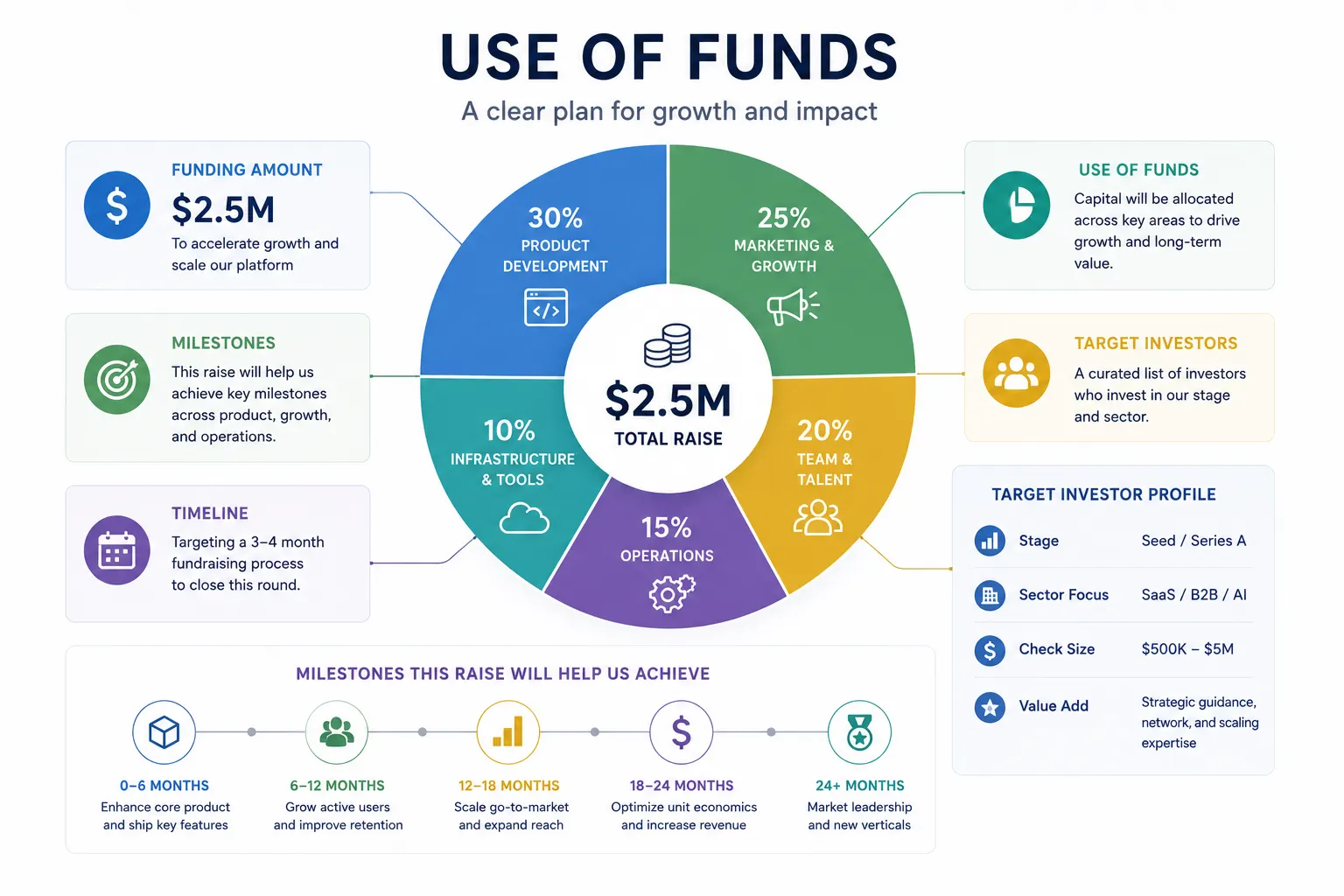
- Funding amount decided, with a clear rationale
- Use of funds broken down specifically
- Milestones the raise is meant to help you hit
- Target investor list, matched to your stage and sector
- Realistic timeline for the raise itself
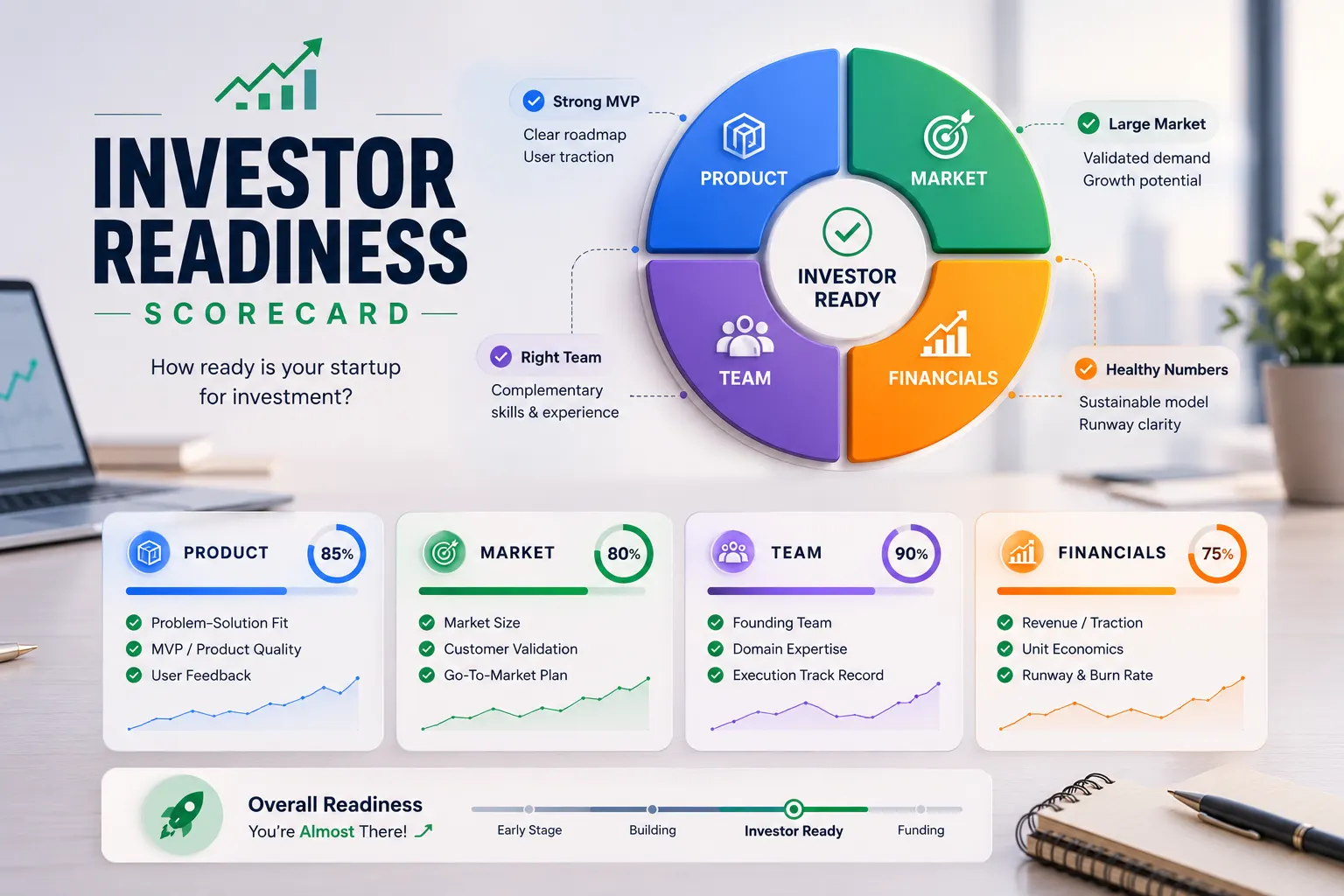
Investment Readiness Wheel
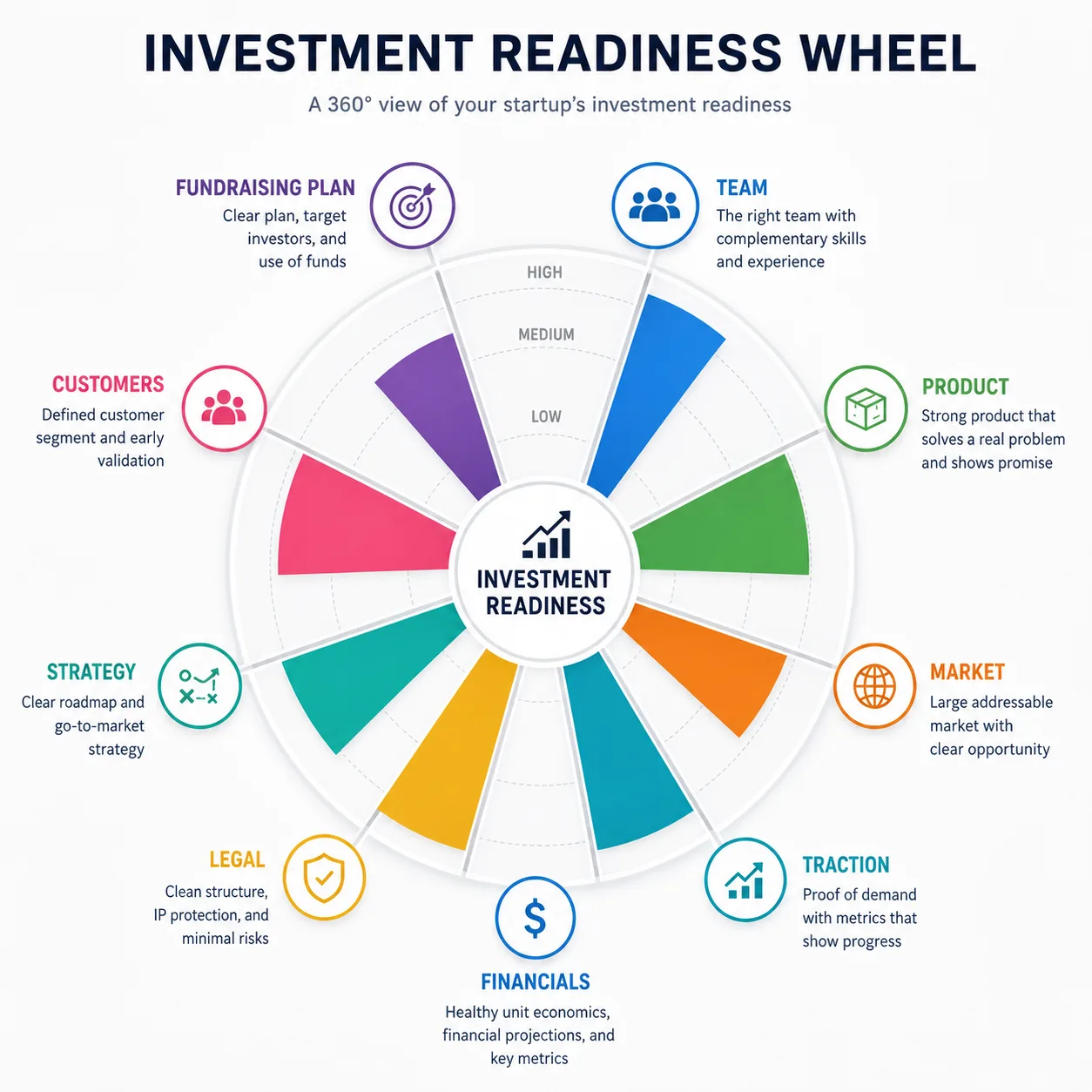
It helps to see all nine checklist categories above as spokes on a single wheel — Team, Product, Market, Traction, Financials, Legal, Strategy, Customers, and Fundraising Plan — rather than as a strictly sequential list. A startup can be strong on Product and Team while still being weak on Financials or Legal, and an uneven wheel is exactly what due diligence tends to expose. Reviewing your own readiness across all nine spokes, rather than just the two or three you feel most confident about, gives a far more honest picture of where you actually stand.
Angel Investors vs. Seed Funds vs. Venture Capital
Different investor types expect different things and move at different speeds, so it's worth being clear on which you're actually approaching:
- Angel investors are typically individuals investing their own money, often earlier and faster than institutional investors, and sometimes more willing to back a strong founder with earlier-stage traction.
- Seed funds are institutional investors specializing in early-stage startups, usually expecting some traction and a clearer business model than angels require, with a more formal due diligence process.
- Venture capital (VC) firms, particularly at Series A and beyond, expect stronger traction, clearer unit economics, and a credible path to significant scale — the bar for evidence rises substantially compared to angel or seed conversations.
Matching your current stage to the right investor type matters as much as the pitch itself — a seed fund expecting real revenue traction isn't the right first conversation for a team that's a month past validation.
The due diligence depth also scales with the type of investor and the size of the check. An angel writing a small individual check might decide largely on the strength of the founder and a compelling early demo. A seed fund deploying institutional capital will typically want to see a data room, verified customer references, and a defensible financial model. A venture firm at Series A will go further still, often bringing in outside advisors to stress-test the market sizing and technical architecture. Knowing which level of scrutiny to expect helps you prepare the right depth of documentation for the conversation you're actually about to have.
What Investors Actually Look For
Across all these categories, investors are ultimately weighing:
- Strong founders — coachable, resilient, and clear-eyed about their own weaknesses
- Execution ability — evidence you can ship and adjust quickly, not just plan
- Market size — is the opportunity large enough to justify the risk they're taking
- Traction — real usage or revenue, however early
- Scalability — can this grow without every unit of growth requiring proportional new cost
- Defensibility — what stops a well-funded competitor from copying this quickly
- Financial discipline — do you know your own numbers cold, without needing to check a spreadsheet mid-conversation
- Clear vision — a specific, believable picture of where this goes in three to five years
Notice that traction and financial discipline appear on this list alongside softer factors like founder resilience and vision. Investors are consistently weighing both — a brilliant founder with no evidence yet is a bet on potential, while strong traction with a weak or evasive founder raises questions about whether that traction will continue. The strongest pitches connect the two: real evidence, presented by a founder who clearly understands exactly why the numbers look the way they do.
Metrics Investors Care About
Different metrics matter at different stages, and knowing which ones apply to you signals real financial discipline:
- CAC (Customer Acquisition Cost) — what it actually costs to acquire a customer, all-in, including marketing spend, tools, and a reasonable share of team time
- LTV (Lifetime Value) — what a customer is worth to you over their full relationship with the business, not just their first payment
- MRR / ARR (Monthly / Annual Recurring Revenue) — the core metric for subscription businesses, tracked over time rather than as a single snapshot, since the trend matters more than any single month's number
- Churn — how many customers leave in a given period, and just as importantly, why they're leaving
- Runway — how many months of operation remain at current burn rate, calculated precisely rather than rounded optimistically
At pre-seed, investors mostly care about problem validation and early signals rather than polished unit economics. By seed stage, CAC, early retention, and a believable LTV story start to matter. By Series A, MRR/ARR growth trends, churn, and a defensible CAC-to-LTV ratio become central to the conversation. Knowing which of these actually applies to your stage — and not overstating maturity you don't yet have — builds more credibility than pretending every metric is fully dialed in.
A realistic scenario: an early-stage SaaS startup with ₹2 lakh in MRR, 8% monthly churn, and a CAC-to-LTV ratio just above 1:3 is a fundamentally different, and generally more fundable, story than one with the same MRR but a CAC-to-LTV ratio close to 1:1 — the second business is effectively spending nearly as much to acquire a customer as that customer will ever be worth, a warning sign most seed investors will catch quickly.
A second scenario worth understanding: two startups both show ₹5 lakh in MRR, but one has been flat at that number for four months while the other grew from ₹2 lakh over the same period. Investors will almost always favor the second, even at a lower absolute number, because the growth rate — not just the current snapshot — is what a funding round is meant to accelerate. A flat MRR line is a much harder story to raise against than a modest but clearly rising one.
Common Mistakes Before Fundraising
- Raising too early, before there's real traction or evidence to show
- No traction to point to beyond the product existing
- Unrealistic valuation expectations relative to actual stage and metrics
- Weak financial projections that don't hold up to basic questioning
- A poor pitch deck that buries the actual traction and numbers under design
- No customer validation behind the core assumptions
- Ignoring unit economics entirely, or not knowing them well enough to discuss confidently
- Pitching every investor instead of researching and targeting the right ones for your stage and sector
The pattern across nearly all of these mistakes is the same: mistaking activity (having a deck, having meetings, having a valuation in mind) for actual readiness (having evidence). A founder who's had fifteen investor meetings with no offers should look harder at which of these gaps is actually driving the pattern, rather than assuming the answer is simply more meetings.
Investor Due Diligence Checklist
Once an investor is seriously interested, expect scrutiny across several areas — preparing for these in advance saves significant time and avoids awkward gaps mid-process:
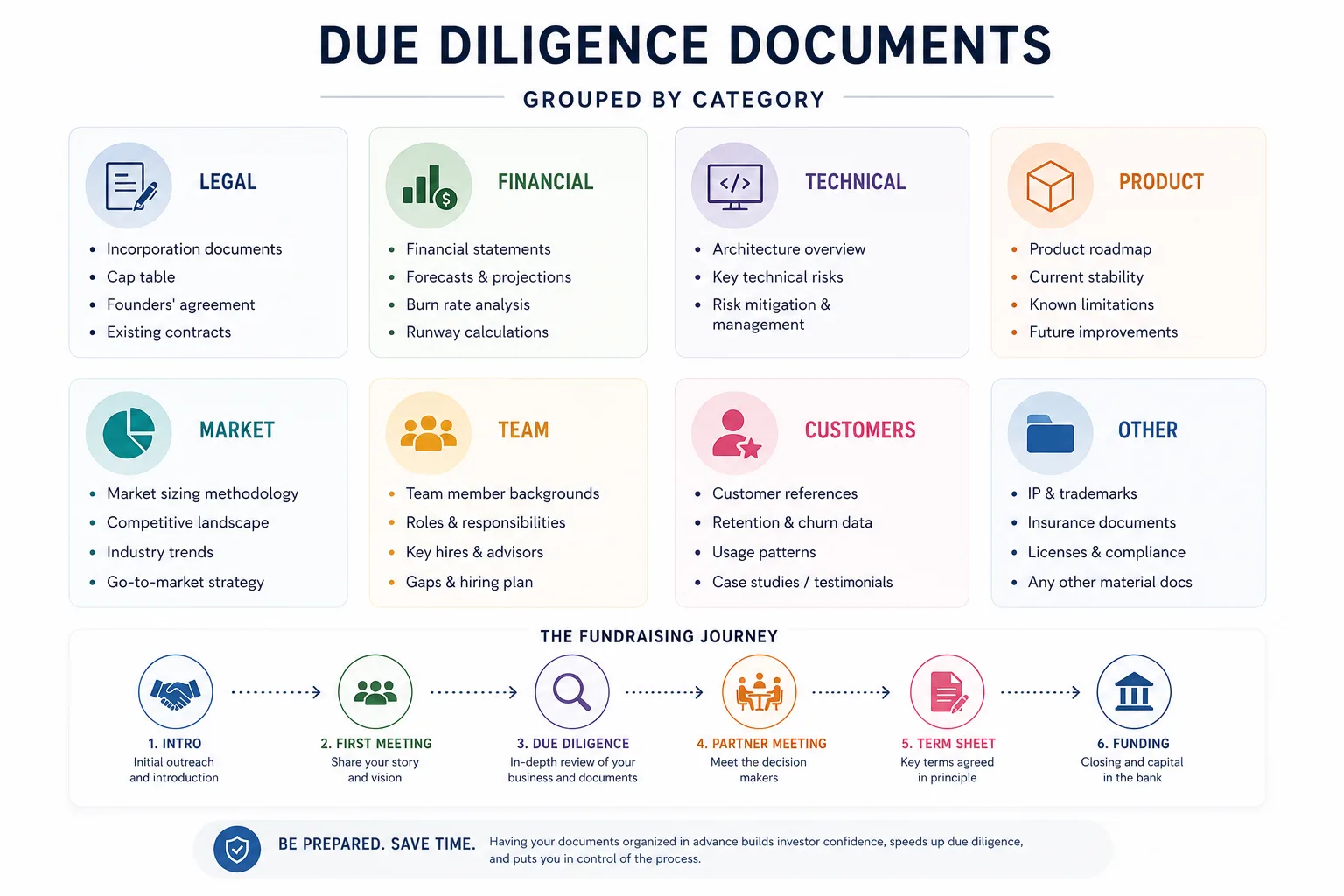
- Legal — incorporation documents, cap table, founders' agreement, any existing contracts
- Financial — statements, forecasts, burn rate, and runway calculations
- Technical — architecture overview, key technical risks, and how they're managed
- Product — roadmap, current stability, and known limitations
- Market — sizing methodology and competitive landscape
- Team — backgrounds, roles, and any gaps in the current team
- Customers — references, retention data, and usage patterns investors can verify
The process typically moves through an initial intro, a first meeting, a due diligence phase, a partner meeting, a term sheet, and finally funding itself — each stage narrowing the investor pool but raising the depth of scrutiny.
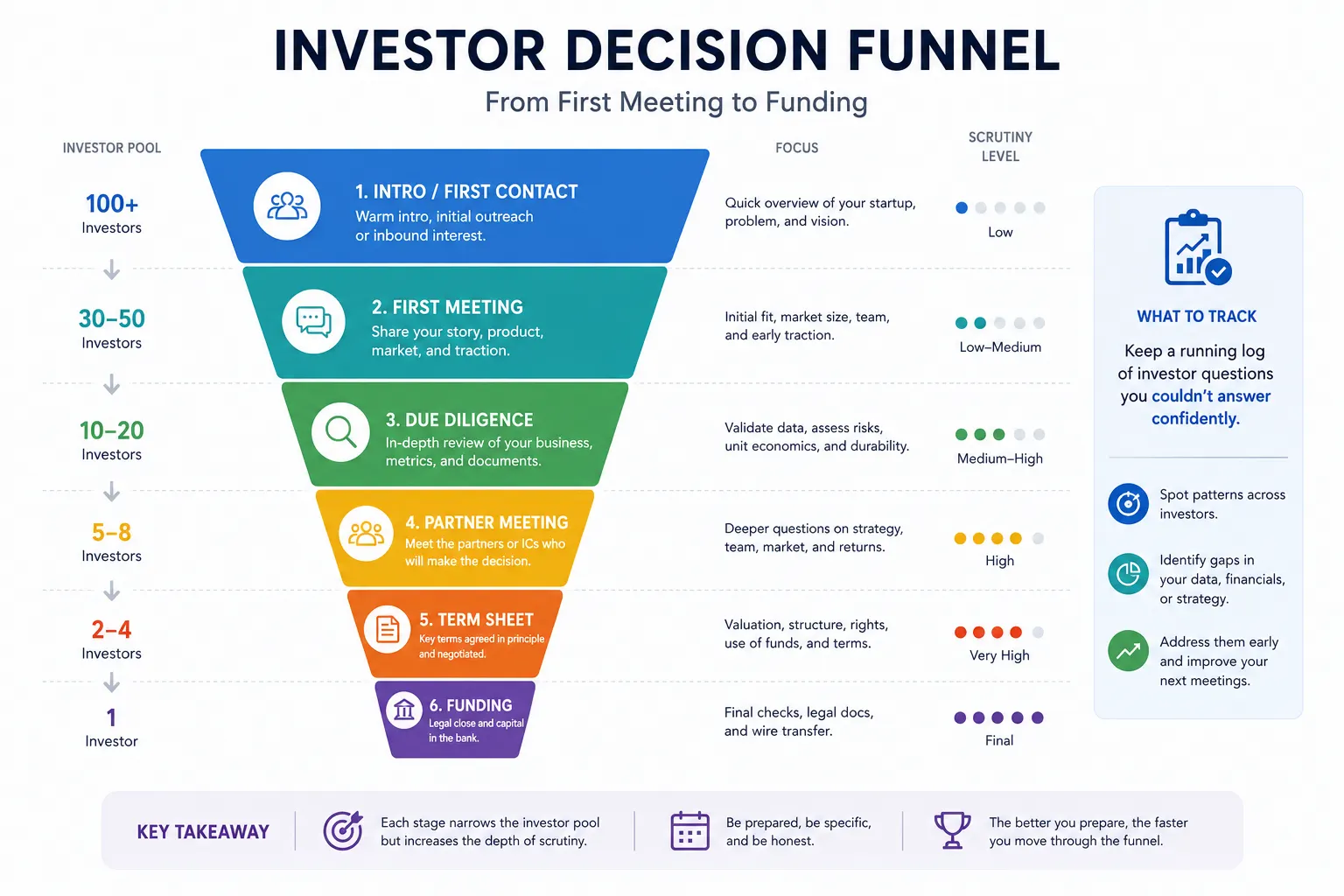
A useful habit during this stage: keep a running log of every question an investor asks that you couldn't answer confidently on the spot. Patterns tend to emerge quickly — if three separate investors ask about the same gap in your financials or customer data, that's a clear signal of what to shore up before the next round of meetings, rather than something to hope the next investor won't notice.
Downloadable Investor Readiness Checklist
To make this practical rather than theoretical, keep three working documents ready before you start outreach:
- A fundraising checklist — the categories above, tracked as a simple pass/fail list you update honestly
- A data room structure — a single organized folder covering legal, financial, product, and team documents, so due diligence doesn't become a scramble
- An investor outreach tracker — a simple spreadsheet logging who you've contacted, their stage focus, and where each conversation currently stands
Most founders underestimate how much a simple, well-organized tracker helps once outreach passes ten or fifteen investors — memory alone stops being reliable, and a missed follow-up at the wrong moment can cost real momentum in a process where investor interest is often time-sensitive.
A printable version of this checklist is available as part of Incubetr's founder resources, alongside the business plan and MVP templates covered in our earlier guides.
FAQs
How do I know if my startup is ready for investors? Work through the checklist above honestly — if problem validation, product, customers, and financials each have real evidence behind them, you're in a reasonable position to start preparing outreach.
What documents do investors ask for? Expect requests across legal (incorporation, cap table), financial (statements, forecasts), and product/team documentation — the due diligence checklist above covers the categories most investors work through.
How do I raise seed funding specifically? Seed investors generally expect some real traction and a clearer business model than angel investors require — focus on demonstrating early retention and a believable path to your next milestone, not just the idea itself.
What's the difference between a SAFE agreement and a convertible note? Both let investors provide funding that converts to equity later rather than pricing the round immediately, though the specific terms and mechanics differ — a lawyer or experienced advisor should review whichever structure you're considering, since the details matter significantly.
How much should I raise? Base the amount on specific milestones you need to hit before your next round, plus a buffer for delays, rather than an arbitrary round number — investors respond better to a specific, justified ask than a vague one.
How long does it typically take to close a funding round? Most early-stage rounds take three to six months from first serious outreach to closing, even when the pitch and traction are strong — building in this timeline early prevents a founder from running low on runway mid-raise, which weakens their negotiating position considerably.
Final Thoughts
The goal isn't to raise funding quickly. It's to become the kind of company investors compete to invest in — one where the traction, financials, and team are strong enough that the pitch is simply confirming what the evidence already shows.
Work through this checklist honestly, close the gaps that matter most, and treat fundraising readiness as an ongoing state to maintain rather than a one-time sprint before your first meeting.
At Incubetr, we help startups become investor-ready by refining business plans, validating markets, strengthening financial models, preparing compelling pitch decks, and connecting founders with the right investors. Instead of just helping you raise funding, we help you build a business that deserves it. Explore how to validate a startup idea, how to find the right co-founder, or our startup grants guide for the other pieces of this journey.