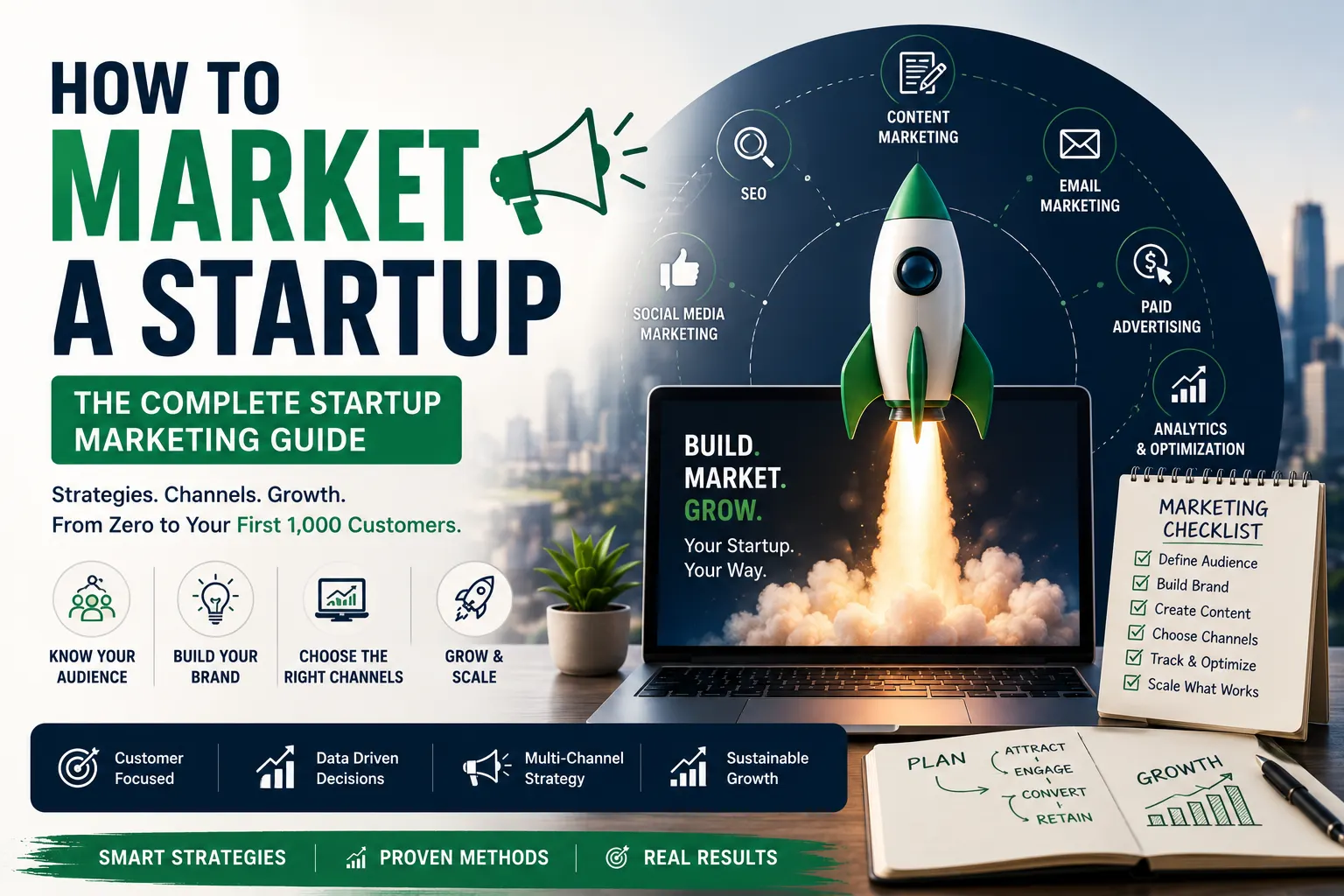
How to Market a Startup: The Complete Startup Marketing Guide
Incubetr Team
·22 July 2026
How to Market a Startup: The Complete Startup Marketing Guide
A great product with no one who knows it exists isn't a startup yet — it's a well-built secret. Knowing how to market a startup is what turns a validated idea and a working MVP into an actual business with paying customers. This guide covers the complete picture: positioning, organic and paid channels, email, community, growth loops, and the tools worth using at each stage.
Most of what gets written about marketing is aimed at companies with an existing brand, budget, and audience. Startup marketing starts from zero on all three, which means the playbook has to be different — smaller experiments, cheaper channels, and a much higher tolerance for things that don't work on the first try.
Table of Contents
- Why Startup Marketing Is Different
- The Startup Marketing Funnel
- Step 1: Brand Positioning and Your Value Proposition
- Step 2: Define Your Customer Persona
- Step 3: Build a Go-To-Market Roadmap
- Organic Marketing Channels
- Paid Marketing Channels
- Organic vs. Paid Growth
- Email Marketing
- Choosing Your Customer Acquisition Channels
- The Marketing Flywheel
- Mapping the Customer Journey
- Startup Growth Loops
- Getting to Your First 1,000 Customers
- Marketing Tools Worth Using
- Metrics That Actually Matter
- How to Market a Startup With No Money
- Common Startup Marketing Mistakes
- Startup Marketing Checklist
- FAQs
- Final Thoughts
Why Startup Marketing Is Different
Marketing at an established company means optimizing channels that already work. Startup marketing means finding out which channels work at all — usually with no brand recognition, a small budget, and a product still being refined based on early feedback.
That difference changes the whole approach. Instead of running the same playbook as a bigger competitor, early-stage marketing is closer to a series of small experiments: try a channel, measure honestly, keep what works, drop what doesn't. Founders who treat marketing as one big campaign to get right the first time tend to burn budget before they learn anything useful.
There's also a sequencing difference that catches first-time founders off guard: marketing at a startup often starts before the product is finished. Waitlists, early content, and community presence during your validation and MVP stages are marketing, even though there's nothing to buy yet. Waiting until launch day to start thinking about marketing means starting the awareness stage of your funnel from a complete standstill, right when you need momentum most.
The Startup Marketing Funnel
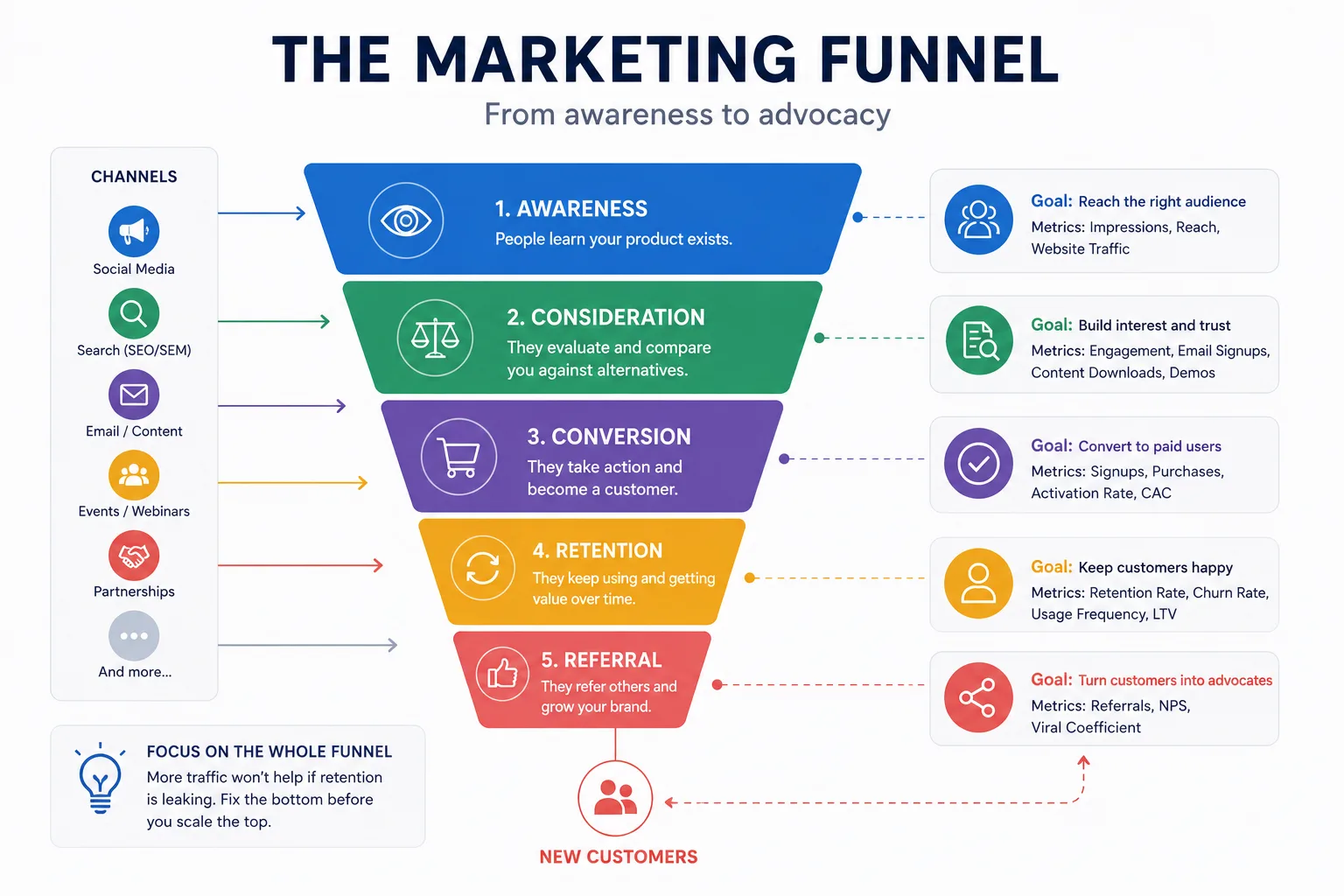
Every marketing channel eventually feeds the same funnel:
- Awareness — someone learns your product exists
- Consideration — they compare it against alternatives
- Conversion — they sign up or buy
- Retention — they keep using it
- Referral — they tell someone else
Most early-stage founders focus entirely on the top of this funnel — driving more traffic and signups — while retention and referral quietly leak away the customers they worked hard to acquire. A useful early habit: before spending more to fill the top of the funnel, check whether the bottom of it is actually working.
A quick way to audit your own funnel: pull up your numbers at each stage and look for the biggest single drop-off. If ten times more people visit your landing page than sign up, that's a conversion problem worth fixing before spending more on traffic. If plenty of people sign up but few come back a second time, that's a retention problem no amount of new acquisition will solve. Fixing the biggest leak first is almost always higher-leverage than adding a new channel at the top.
Step 1: Brand Positioning and Your Value Proposition
Before choosing channels, get specific about what makes your product worth choosing. Brand positioning answers: in the customer's mind, what category are you in, and why are you the better choice within it?
Your value proposition should be a single, clear sentence a customer could repeat back to a friend. If you validated your idea already, this shouldn't require new research — it should come directly from the language real customers used to describe their problem during interviews, not language your team invented internally. Product messaging that echoes the customer's own words converts far better than messaging that sounds impressive to the founding team.
Positioning also means being honest about what you're not. A startup trying to appeal to everyone usually ends up compelling to no one — a sharper, narrower position ('the invoicing tool built specifically for freelance designers' rather than 'invoicing software for everyone') tends to convert better precisely because it signals the product was built with a specific person's problem in mind, not a generic market.
Step 2: Define Your Customer Persona
Marketing to 'everyone' is marketing to no one. A clear customer persona — who they are, where they spend time online, what they're currently doing about this problem — determines almost every decision that follows: which channels to use, what tone to write in, and which platforms are even worth testing.
If you haven't built this persona through real customer interviews yet, our guide on how to validate a startup idea covers exactly that groundwork, and your business plan should already have an early version worth reusing here.
Beyond demographics, the most useful part of a marketing-focused persona is usually behavioral: where do they go when they have a work question, which social platforms do they actually check daily versus which ones they signed up for and forgot, and what would make them trust a recommendation from a stranger online. Those behavioral details, more than age or income, are what actually determine which channels are worth testing first.
Step 3: Build a Go-To-Market Roadmap
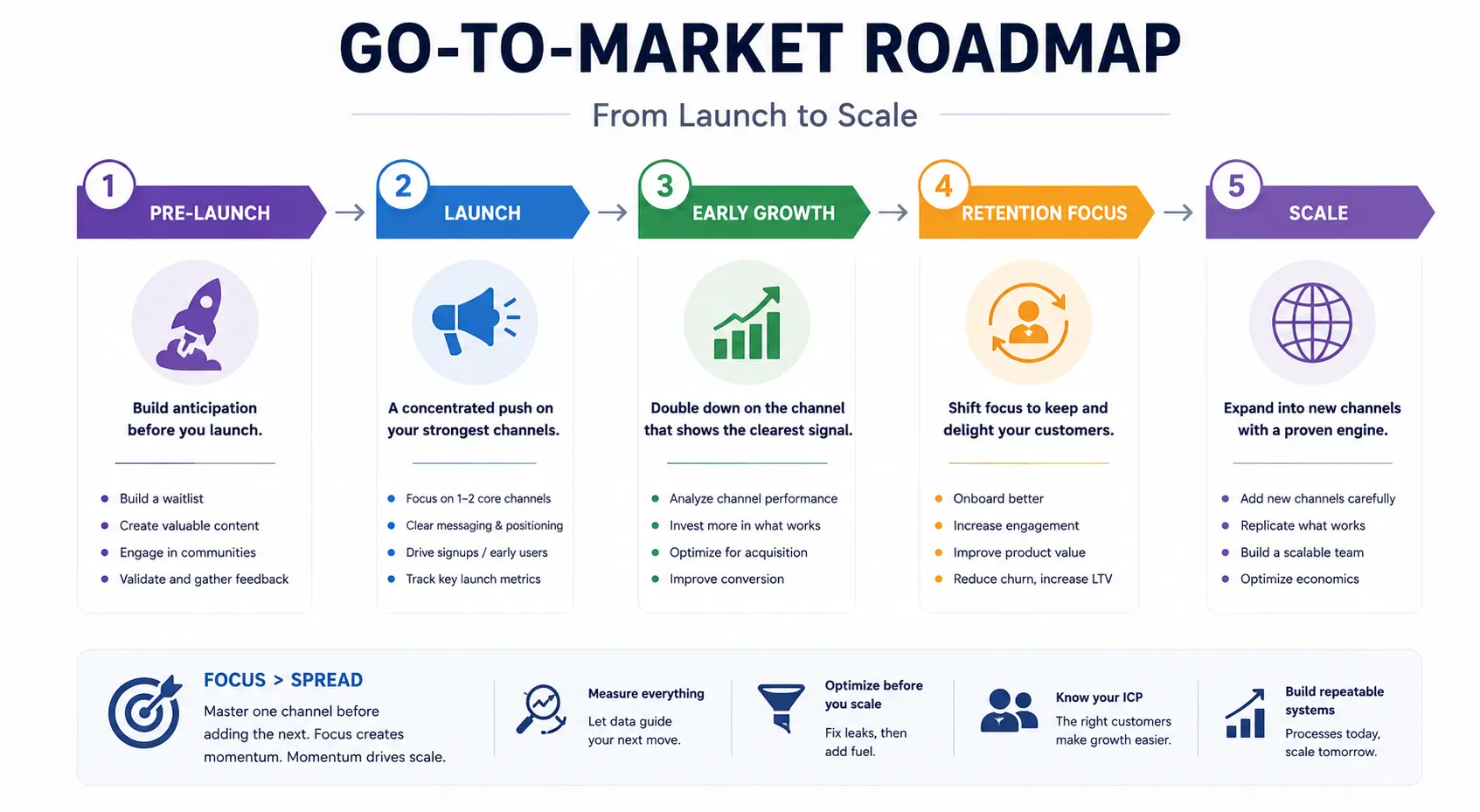
A go-to-market strategy sequences your marketing efforts instead of trying everything simultaneously. A simple early roadmap:
- Pre-launch — waitlist, early content, and community presence to build anticipation
- Launch — a concentrated push across your one or two strongest channels
- Early growth — double down on whatever channel showed the clearest signal
- Retention focus — shift effort toward keeping the customers you've already acquired
- Scale — expand into additional channels once your core one is proven and efficient
Trying to run five channels well from day one usually means running all five poorly. Sequencing forces focus.
A realistic early timeline might look like four to six weeks of pre-launch community and content building, a concentrated one- to two-week launch push, then eight to twelve weeks of focused testing on your strongest one or two channels before deciding what to scale. Treat these timeframes as a starting structure to adjust, not a fixed formula — the right pace depends on how quickly your specific channel produces a clear signal.
Organic Marketing Channels
SEO & Content Marketing
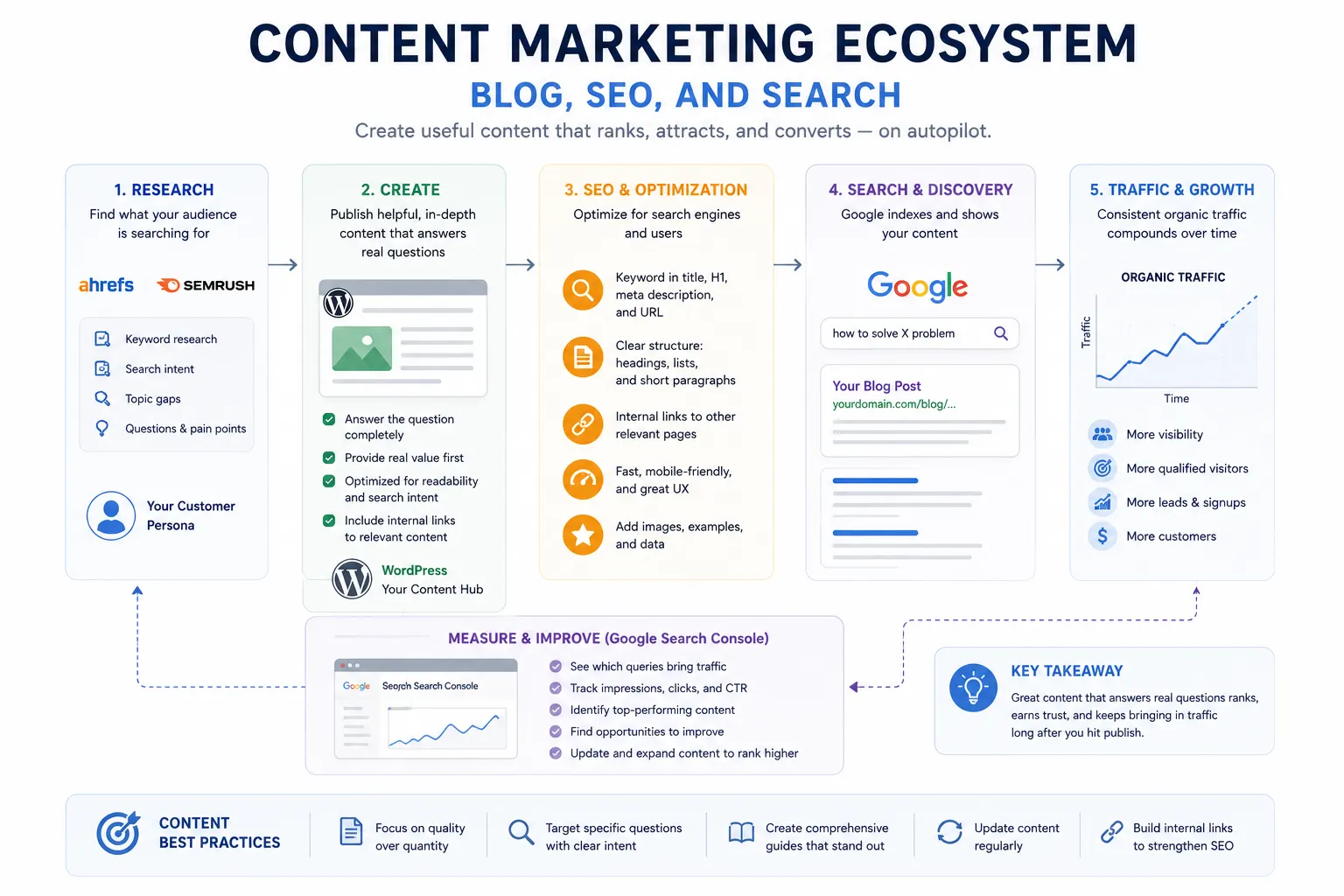
SEO and content marketing compound over time — a blog post ranking on Google keeps bringing in organic traffic long after you've stopped actively promoting it. Tools like Ahrefs and Semrush help identify what your target customers are actually searching for, while Google Search Console shows you what's already driving traffic so you can double down on what's working.
Content works best when it answers a real question your customer persona is searching for, not when it's written primarily to mention your product. WordPress remains a common platform for founders building out a content library outside their core app.
Start with a small number of genuinely useful pieces targeting specific questions your persona searches for, rather than a large volume of shallow posts. One thorough guide that ranks and actually helps the reader tends to outperform ten thin posts that exist mainly to hit a publishing schedule — search engines and readers both reward the former over time.
Social Media Marketing
Pick platforms based on where your specific persona actually spends time, not where marketing advice generally points. LinkedIn tends to work well for B2B and professional audiences; consumer products often see more traction on visual or short-form platforms. Reddit, used carefully and without overt self-promotion, can be a strong source of honest early feedback and awareness within relevant communities. Product Hunt launches can generate a useful early spike of attention, particularly for tools aimed at other founders, developers, or early-adopter tech audiences — though the traffic spike is usually short-lived and works best paired with a channel built for the longer term.
Whichever platform you choose, consistency matters more than frequency — a founder posting genuinely useful updates twice a week for six months builds more trust than a burst of ten posts followed by silence.
Community Building & Referral Marketing
A small, genuinely engaged community of early users is worth more than a large, passive follower count. Referral marketing — incentivizing existing users to invite others — works especially well once you have users who are already getting real value, since referral asks feel authentic rather than desperate at that point.
A simple referral program doesn't need complex tiers or elaborate rewards to start — even a direct, personal ask ('if this has been useful, know anyone else who'd benefit?') sent to your happiest existing users often outperforms a formal program that hasn't been tested yet.
Founder-Led Marketing & Thought Leadership
For early-stage startups with no brand recognition, the founder's own voice often outperforms a polished company account. Sharing what you're building, what you're learning, and even what isn't working yet — on LinkedIn, in communities, or through a newsletter — builds trust faster than generic company messaging, precisely because it's specific and human.
Thought leadership doesn't require a large existing audience to be worthwhile. A founder documenting real decisions and lessons publicly, even to a small following, tends to attract exactly the kind of early adopters and even future co-founders or investors who are drawn to specificity over polish.
Paid Marketing Channels
Google Ads
Google Ads (PPC — pay-per-click) is well suited to capturing demand from people already searching for a solution. It works best once you have a clear value proposition and a landing page that converts — paid traffic sent to a confusing page is money spent teaching you nothing useful.
Start with a small daily budget and a tightly targeted set of keywords rather than a broad campaign — the goal early on is a clear read on cost per conversion for a handful of terms, not maximum reach.
Meta Ads
Meta Ads (Facebook and Instagram) are better suited to demand creation — reaching people who have the problem but aren't actively searching for a solution yet. This usually requires a stronger visual hook and a more top-of-funnel message than search ads do.
Meta's detailed audience and interest targeting can help narrow spend toward your customer persona specifically, but the creative — the actual image, video, or headline — tends to matter more than targeting precision at small budgets, since a weak ad won't convert even to a perfectly targeted audience.
When Paid Advertising Makes Sense
Paid channels make the most sense once you understand your unit economics well enough to know what a customer is actually worth to you — otherwise you're spending real money to learn a lesson organic testing could have taught you more cheaply first.
A reasonable rule of thumb: if you don't yet know your average revenue per customer or how long a customer typically stays, it's usually too early to scale paid spend meaningfully, even if a small test budget is worth running to start gathering that data.
Organic vs. Paid Growth
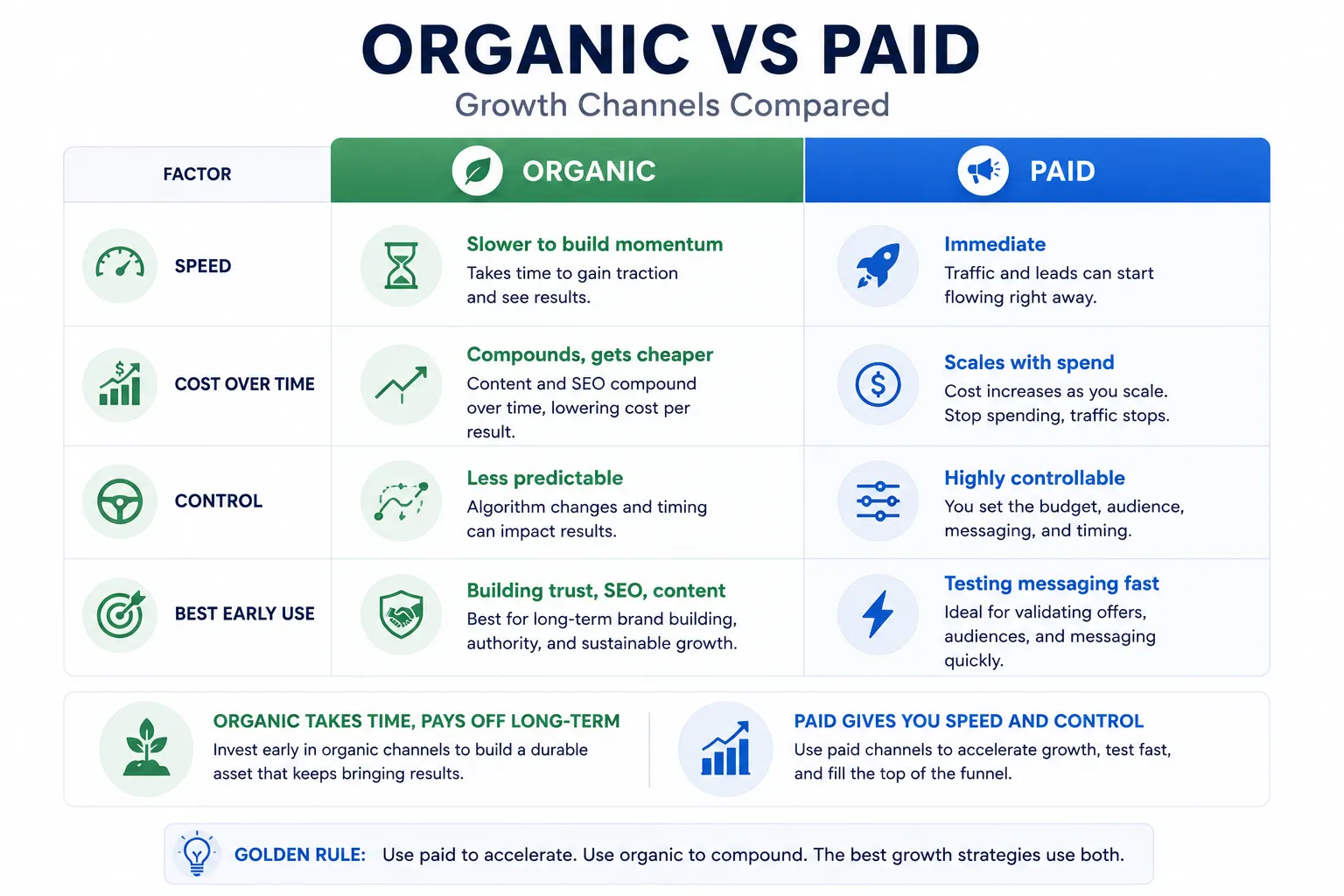
| Organic | Paid | |
|---|---|---|
| Speed | Slower to build momentum | Immediate |
| Cost over time | Compounds, gets cheaper | Scales with spend |
| Control | Less predictable | Highly controllable |
| Best early use | Building trust, SEO, content | Testing messaging fast |
Most startups need both eventually, but the right early mix depends on runway: cash-constrained founders usually lean organic first, while funded startups with clear unit economics can responsibly use paid channels to accelerate learning.
A practical approach many startups land on: use a small, disciplined paid budget specifically to test which messages and audiences convert fastest, then apply what that testing teaches you to the organic content and positioning you're building for the longer term. Paid and organic don't have to compete for the same budget line — they can inform each other directly.
Email Marketing
Email remains one of the highest-return channels available to early-stage startups, largely because you own the list — unlike social platforms, no algorithm change can take it away from you. Tools like Mailchimp or HubSpot make it straightforward to run a simple newsletter, nurture sequence, or product update series.
Start your email list before launch, not after — every landing page and waitlist signup from your validation stage should feed directly into it, so you already have an audience the moment you're ready to launch.
A simple early email sequence covers three things: a welcome message setting expectations, occasional updates on what you're building and why, and a clear, low-pressure way to give feedback. Resist the temptation to over-automate this early — a personal, slightly informal email from a founder often gets read and replied to more than a polished, obviously templated one.
Choosing Your Customer Acquisition Channels
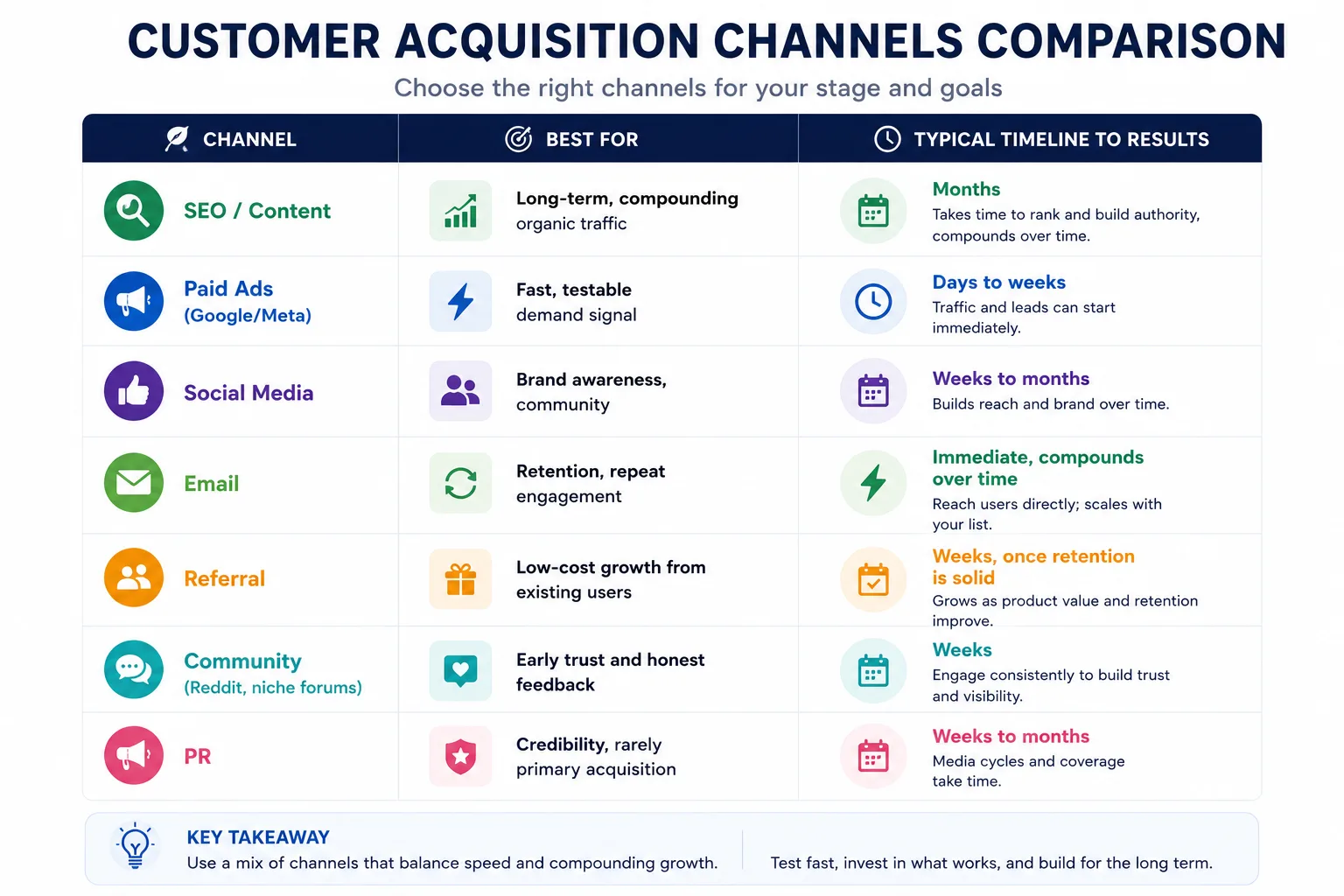
| Channel | Best For | Typical Timeline to Results |
|---|---|---|
| SEO / Content | Long-term, compounding organic traffic | Months |
| Paid Ads (Google/Meta) | Fast, testable demand signal | Days to weeks |
| Social Media | Brand awareness, community | Weeks to months |
| Retention, repeat engagement | Immediate, compounds over time | |
| Referral | Low-cost growth from existing users | Weeks, once retention is solid |
| Community (Reddit, niche forums) | Early trust and honest feedback | Weeks |
| PR | Credibility, rarely primary acquisition | Weeks to months |
Rather than trying all seven, pick two based on where your specific customer persona actually spends time and how much runway you have to wait for results.
A useful way to narrow the list: for each channel, ask honestly whether you'd still choose it if you had zero existing audience or budget advantage there. Founders often default to the channel they personally enjoy using rather than the one their actual customer persona is most likely to respond to — worth checking which one you're actually optimizing for.
The Marketing Flywheel
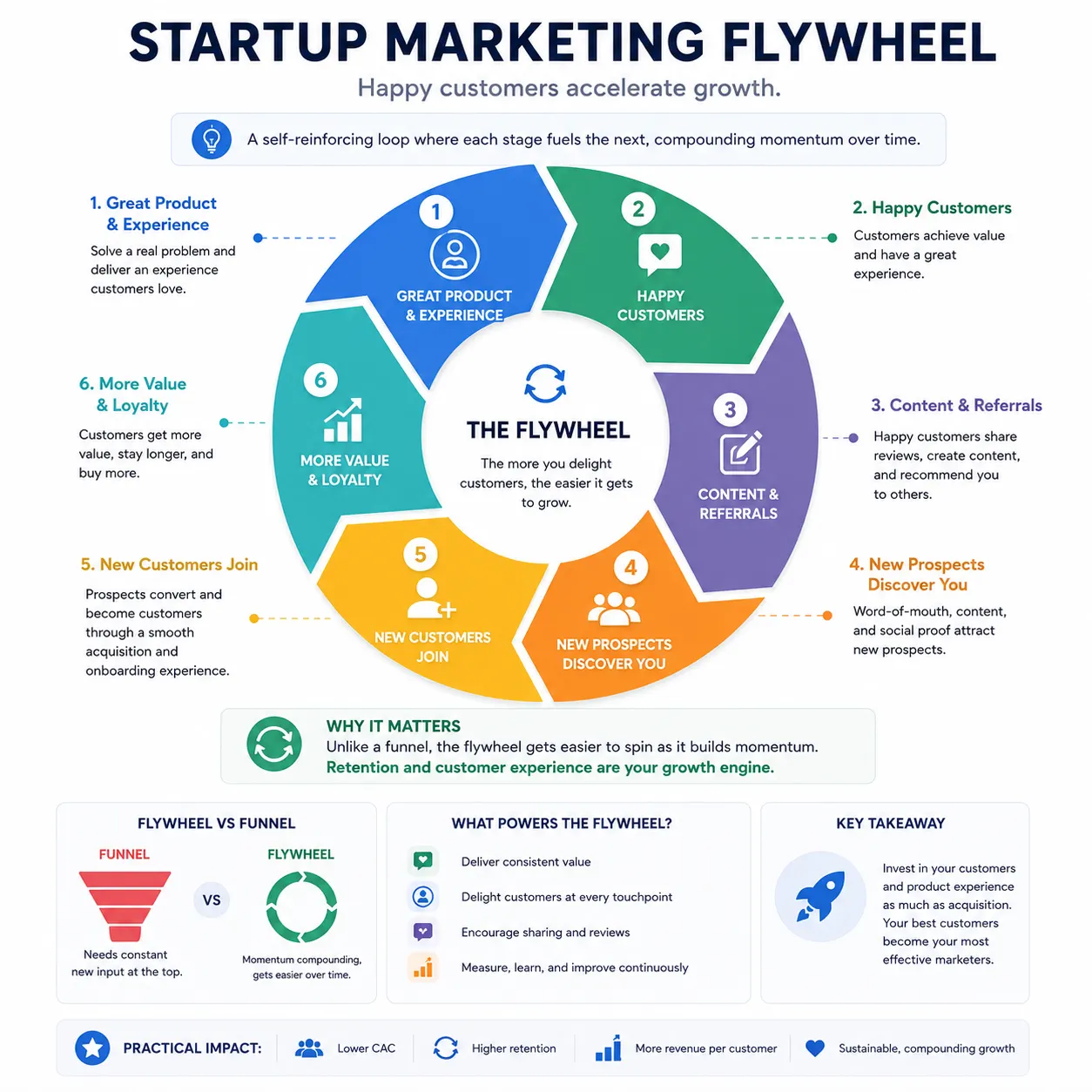
A flywheel reframes marketing as a self-reinforcing loop rather than a one-way funnel: happy customers create content and referrals, which bring in new customers, who become happy customers, who create more content and referrals. Unlike a funnel, which needs constant new input at the top, a flywheel gets easier to spin as it builds momentum — which is exactly why retention and customer experience deserve as much attention as acquisition does.
The practical implication is that time spent improving onboarding, support, or the product experience for existing customers isn't a distraction from marketing — for a flywheel-based business, it often is the marketing, since it directly determines whether customers become advocates or simply churn quietly.
Mapping the Customer Journey
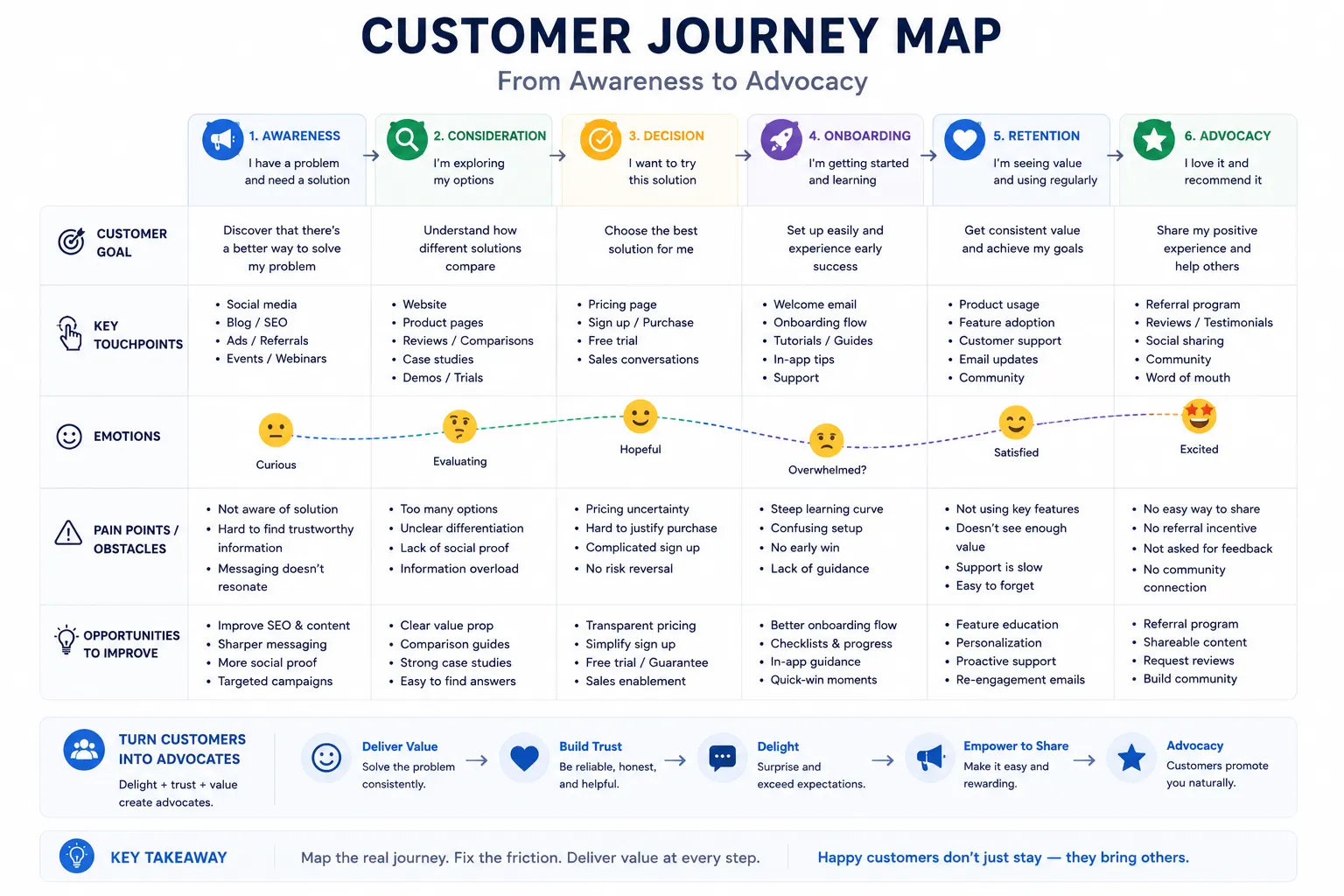
A customer journey map traces the actual path someone takes from first hearing about you to becoming a repeat customer and advocate: where they first encounter you, what convinces them to try it, what almost makes them leave, and what turns them into someone who recommends you. Mapping this honestly — including the points where people drop off — usually reveals more valuable fixes than adding a new acquisition channel would.
A simple way to build this map early: sit down with three or four recent customers and ask them to walk you through, step by step, everything that happened from the moment they first heard about you to the moment they became a regular user. The friction points they mention unprompted are almost always more useful than anything your own team would guess at internally.
Startup Growth Loops
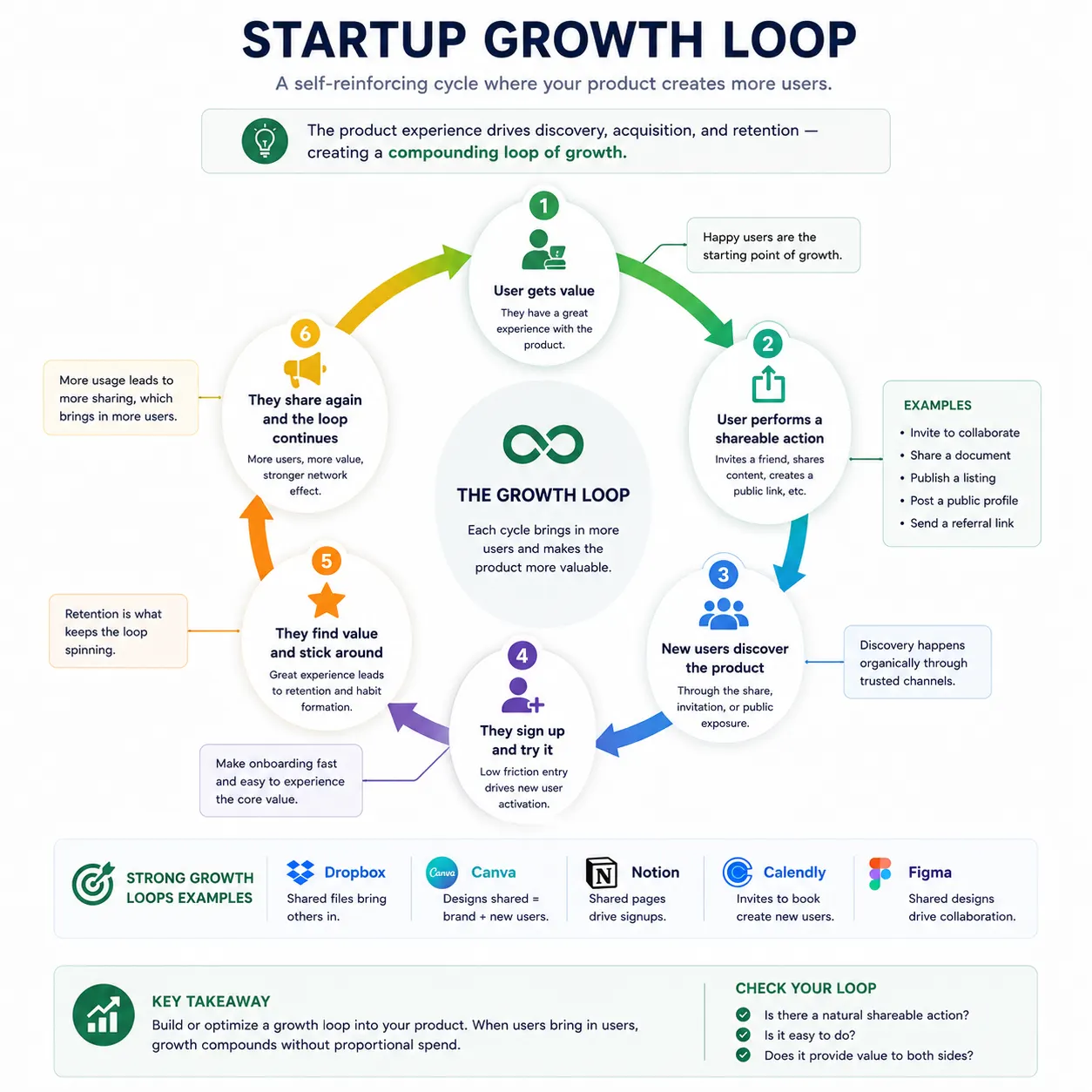
A growth loop is a specific, repeatable mechanism where using the product itself generates new users — a referral credit, a shared document, a public profile that others discover. Unlike a general marketing channel, a growth loop is built into the product experience, which is why it tends to keep compounding without ongoing spend once it's working. Not every startup has an obvious loop available, but it's worth deliberately looking for one rather than assuming growth has to come entirely from external marketing.
A useful exercise: look at the core action your MVP was built around and ask whether it's naturally visible to anyone besides the user performing it. A shared document, an invitation to collaborate, or a public link are all examples of an action that's already social by design — often a smaller product change than a full referral program, and sometimes just as effective.
Getting to Your First 1,000 Customers
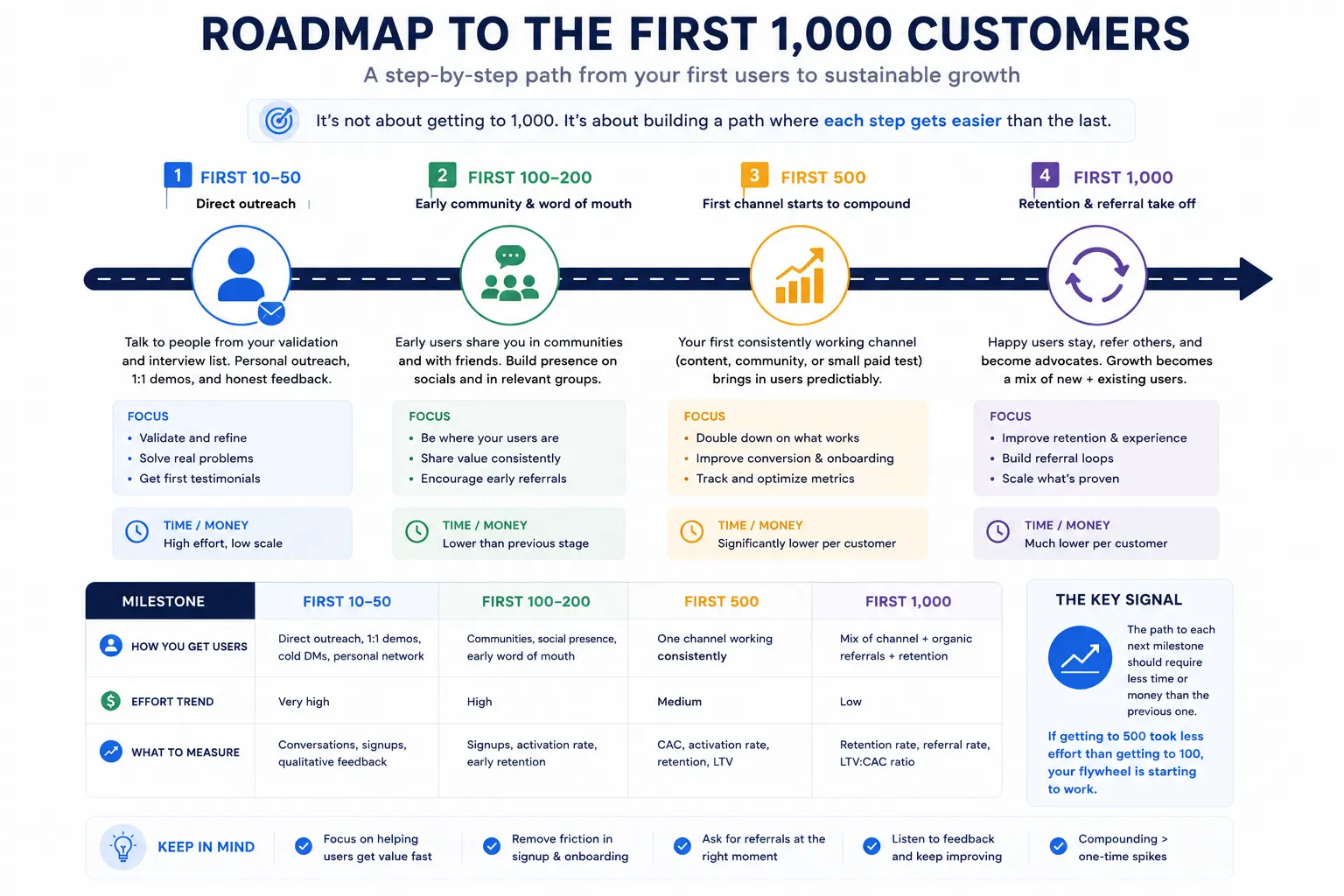
The first 1,000 customers rarely come from a single big campaign — they usually come from a sequence:
- First 10–50 — direct outreach to people from your validation and interview list
- First 100–200 — early community and social presence, plus word of mouth from that first group
- First 500 — your first consistently working channel (often content, community, or a small paid test) starts to compound
- First 1,000 — retention and referral start meaningfully contributing alongside new acquisition
The milestone that matters more than the raw number is whether acquisition is getting easier or harder as you go — an easier path at 1,000 than at 100 means your flywheel is starting to work.
It's worth tracking, at each stage, roughly how much time or money it took to get there compared to the last one. If reaching your second 500 customers took noticeably less effort than the first 500, that's a stronger signal of real product-market fit and marketing traction than the total count alone.
Marketing Tools Worth Using
You don't need a large stack early on — a handful of tools, used consistently, covers most of what a startup needs:
- Google Analytics and Google Search Console — understand traffic and search performance
- Ahrefs or Semrush — keyword research and SEO tracking
- Mailchimp or HubSpot — email marketing and light CRM
- Canva or Figma — design assets for social, ads, and landing pages
- WordPress — a content and blog platform outside your core product
- Notion — organizing your content calendar, campaign notes, and marketing plan
Add tools as a specific need appears, not because a list like this suggests you should have all of them running on day one.
A reasonable starting stack for most first-time founders is just three tools: Google Analytics for traffic, Mailchimp or HubSpot for email, and Notion for organizing the plan itself. Everything else on this list can be added later, once a specific gap makes the tool's purpose obvious rather than theoretical.
Metrics That Actually Matter
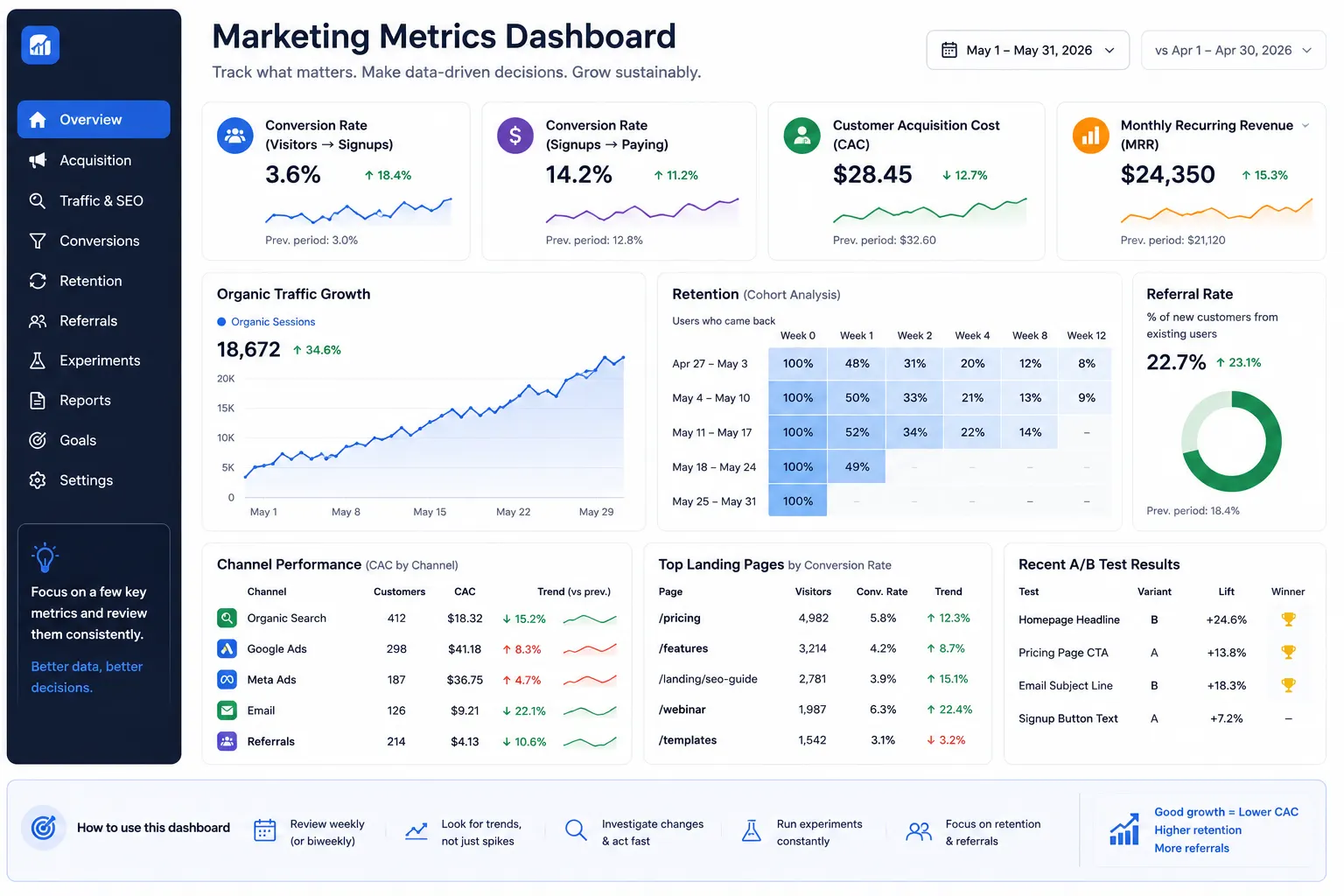
Track fewer metrics, more honestly, rather than a large dashboard nobody actually reviews:
- Conversion rate — visitors to signups, and signups to paying customers
- Customer acquisition cost (CAC) — what each channel actually costs per customer, including your own time
- Organic traffic growth — whether SEO and content are compounding over time
- Retention — the metric most founders under-track relative to how much it matters
- Referral rate — how many new customers come from existing ones
Run small A/B tests on headlines, landing page copy, and email subject lines rather than guessing which version performs better — even simple tests often produce results that surprise the team that wrote both versions.
Review these numbers on a fixed weekly or biweekly schedule rather than only when something feels off — a regular habit of checking the same metrics catches problems (and opportunities) far earlier than an occasional, reactive glance at the dashboard.
How to Market a Startup With No Money
A limited budget doesn't rule out real growth — it just narrows which channels are realistic:
- Lean on founder-led content and community participation, which cost time rather than money
- Prioritize SEO and content marketing, which compounds without ongoing spend once it's live
- Use organic social and community channels (Reddit, relevant LinkedIn groups) instead of paid reach
- Ask for referrals directly from your earliest, happiest users rather than waiting for a formal program
- Pursue PR and press coverage opportunistically, particularly around a genuine launch or milestone
The common thread across all five: substitute time and consistency for budget, and be patient about the compounding channels rather than expecting immediate results.
Common Startup Marketing Mistakes
- Marketing to everyone instead of a specific, well-defined persona
- Chasing every channel at once instead of sequencing a focused go-to-market roadmap
- Spending on paid ads before the landing page converts organic traffic well
- Ignoring retention while pouring all effort into new acquisition
- Copying a bigger competitor's playbook without their budget, brand, or existing audience
- No tracking, so decisions are made on impressions rather than actual data
- Giving up on a channel too early, before it's had a fair, measured test
Most of these mistakes share a root cause: reacting to what feels urgent or exciting in the moment, rather than sticking to the sequence and metrics laid out earlier in this guide. A written go-to-market roadmap is worth revisiting specifically because it's easy to abandon under pressure.
Startup Marketing Checklist
✔ Brand positioning and value proposition defined ✔ Customer persona documented ✔ Go-to-market roadmap sequenced ✔ Landing page live and converting ✔ One or two core channels chosen and tested ✔ Email list and welcome sequence set up ✔ Analytics and search console installed ✔ Retention and referral tracked, not just new signups ✔ Metrics dashboard reviewed on a regular schedule
FAQs
How do I market a startup with no money? Focus on founder-led content, SEO, community participation, and direct referral asks — channels that cost time rather than ad spend, accepting that results will compound more slowly than paid channels would.
How do I market a startup before launch? Build a waitlist, start publishing content addressing your customer persona's problem, and get involved in relevant communities early, so there's already an audience the moment you launch.
How do I market a SaaS startup specifically? Lean into content and SEO around the specific problem you solve, since SaaS buyers often research extensively before committing, and prioritize a free trial or freemium tier that lets your product do some of the convincing itself.
What are the best marketing channels for early-stage startups? It depends entirely on where your specific customer persona spends time — there's no universal best channel, only the one or two channels that match your audience and budget most closely.
How do I get my first startup customers? Start with direct outreach to the people you interviewed during validation, then expand into community presence and content once that first small group is engaged and providing feedback.
Final Thoughts
Knowing how to market a startup isn't about mastering every channel at once — it's about sequencing a small number of the right channels for your specific customer, measuring honestly, and being patient with the ones that compound over time. Positioning, persona, and retention matter more in the early days than any single clever campaign.
At Incubetr, we help founders go from validated idea to a working go-to-market plan — pairing marketing strategy with the business planning, MVP development, and fundraising support that make it stick. Explore how to find a co-founder, our startup funding guide, or the investor readiness guide for what comes after your marketing engine is running.